

We started with products we inherited: grievances, property management, CCTV, finance—the usual categories of government technology. At first, the problem appeared to be one of product quality. Government software was fragmented, difficult to use, and expensive to change. Build better products, make them configurable, create reusable components, and perhaps much of this could be fixed.
But the more government systems you encounter, the more obvious it becomes that configurability itself is not enough.
The Limits of Configuration
There is simply too much variation. A grievance system in one city is not quite the grievance system in another. Departments change. Escalation hierarchies change. SLAs change. Forms change. Terminology changes. Approval structures change. Integrations change. What appears from the outside to be the same government process often turns out to be dozens of subtly different processes.
Traditionally, software companies deal with this by accumulating configuration. Then configuration becomes customization. Customization becomes branches. Branches become technical debt. Eventually, every deployment becomes its own standalone product.
Generative AI gives us an opportunity to approach this differently.
From Configuration to Spec-to-Prod
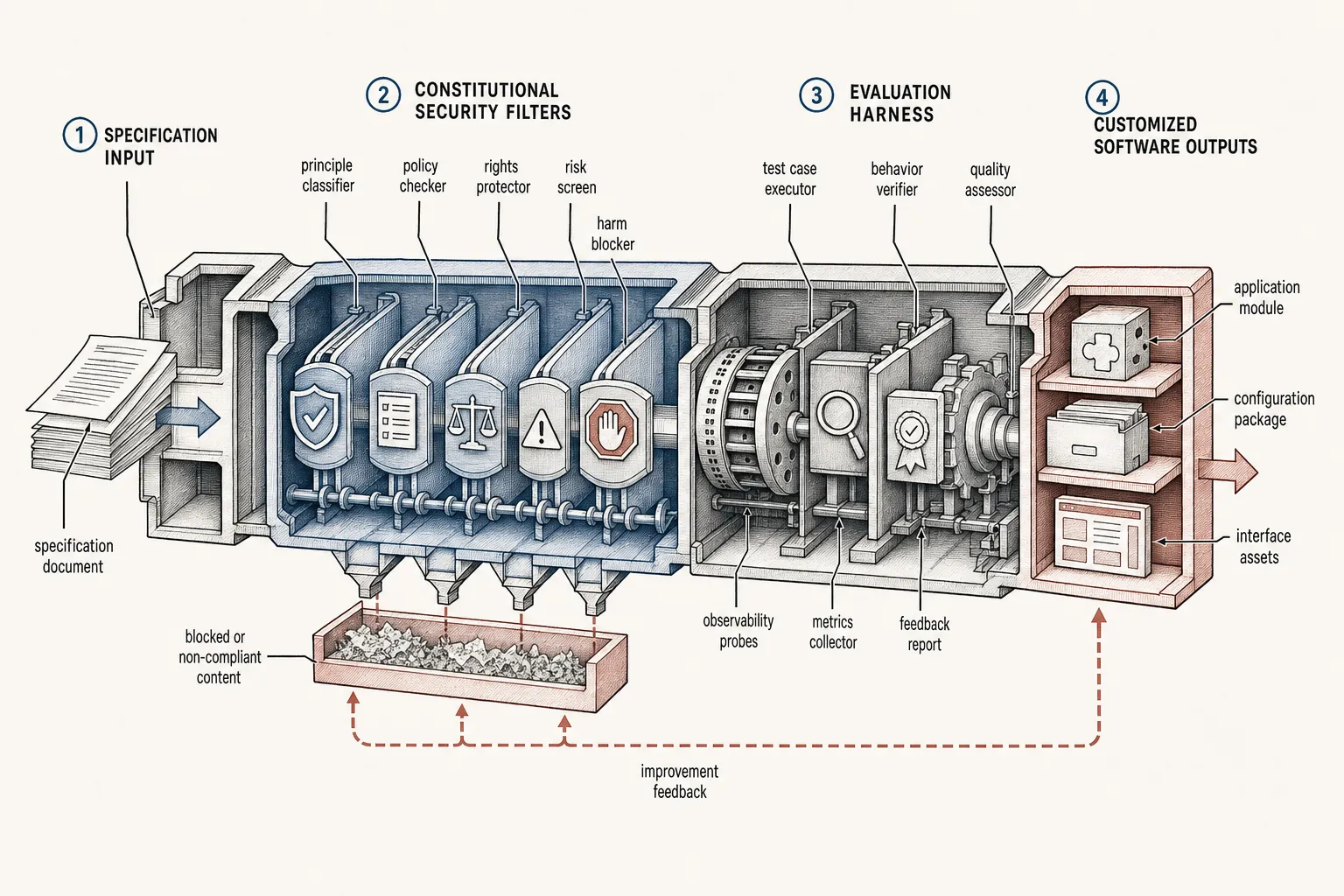
Instead of attempting to anticipate every possible variation, we can describe what an implementation needs in plain language. The requirement becomes a specification. The specification becomes the product. This is spec-to-prod.
But generating software is only half of the problem. If every implementation can mutate freely, we have simply automated the creation of technical debt. The system therefore needs a constitution: a set of things that must remain invariant even as implementations change.
Security requirements might be constitutional. Auditability might be constitutional. Certain data contracts, permission structures, accessibility standards, and interoperability principles might be constitutional. Everything else can potentially vary.
Alongside this sits an evaluation harness. If Karnataka asks for a particular grievance workflow and Punjab asks for another, we should be able to calculate the difference—not merely at the level of code, but at the level of behaviour:
- What changed?
- Why did it change?
- Did it violate the constitution?
- Did it perform better?
- Should that change remain specific to this deployment, or is it something that should improve the underlying product for everyone?
Suddenly, variation stops being purely a maintenance burden; it becomes information. Every implementation teaches the system something about how governments actually work.
requirement → specification → product → diff → evaluation → improved product
If this works, an enormous part of the traditional government-software problem begins to disappear. Which raises a more important question: once software itself becomes relatively easy to produce and adapt, what is left to solve?
Quite a lot.
Software Was Only One Layer of the Problem
The deeper constraint on government technology is not the absence of applications, but the absence of reliable foundational data. Government data reflects the institutions that produced it. It exists in silos because departments are siloed. It uses inconsistent identifiers because systems were procured independently. It contains missing coordinates, duplicate entities, free-text addresses, old boundaries, incompatible schemas, and records whose meaning is obvious to the official who uses them every day but opaque to everybody else.
We have encountered this repeatedly. Geospatial datasets may be years out of date. Management information systems often capture transactions without providing a reliable representation of the physical world. Utility databases contain another version of the same reality, but the entities rarely align cleanly with those in other departmental systems.
Even something apparently simple like an address can become surprisingly difficult. An address written in a property database may not correspond neatly with the address in a grievance, the location returned by a geocoder, or the building visible in satellite imagery.
The problem, therefore, isn’t merely integrating databases. It is reconstructing reality from imperfect evidence. And this becomes dramatically more important in the age of AI.
AI Needs Data Drivers
There is an understandable temptation to put an LLM on top of existing government databases and call the resulting interface an AI system. But intelligence sitting on unreliable foundations remains unreliable. Before agents can reason about a city, they need a representation of the city that they can actually reason over.
That means building data drivers and engines capable of converting noisy operational information into foundational data.
Some of these engines will be mundane but essential: address parsers, geocoders, schema mappers, and document parsers. Others become substantially more sophisticated: entity resolution, temporal reconciliation, geospatial matching, multimodal evidence fusion, confidence estimation, and provenance tracking.
The objective isn’t necessarily to create one immaculate master database. Reality is rarely that cooperative. The objective is to create a continuously improving representation of what we believe to be true, why we believe it, when we last observed it, and how confident we are.
Consider property taxation. A traditional property system answers: Which properties are registered in our database? A foundational intelligence system should be capable of asking: Which properties appear to exist in the physical world? And then: Which of those appear in the tax database? Which do not? Which buildings have changed since the last observation? Which records probably refer to the same physical property? What evidence supports each conclusion? How confident are we? When was that evidence collected?
The difference is fundamental: one system describes a database; the other attempts to describe reality.
From Systems of Record to Systems of Reality
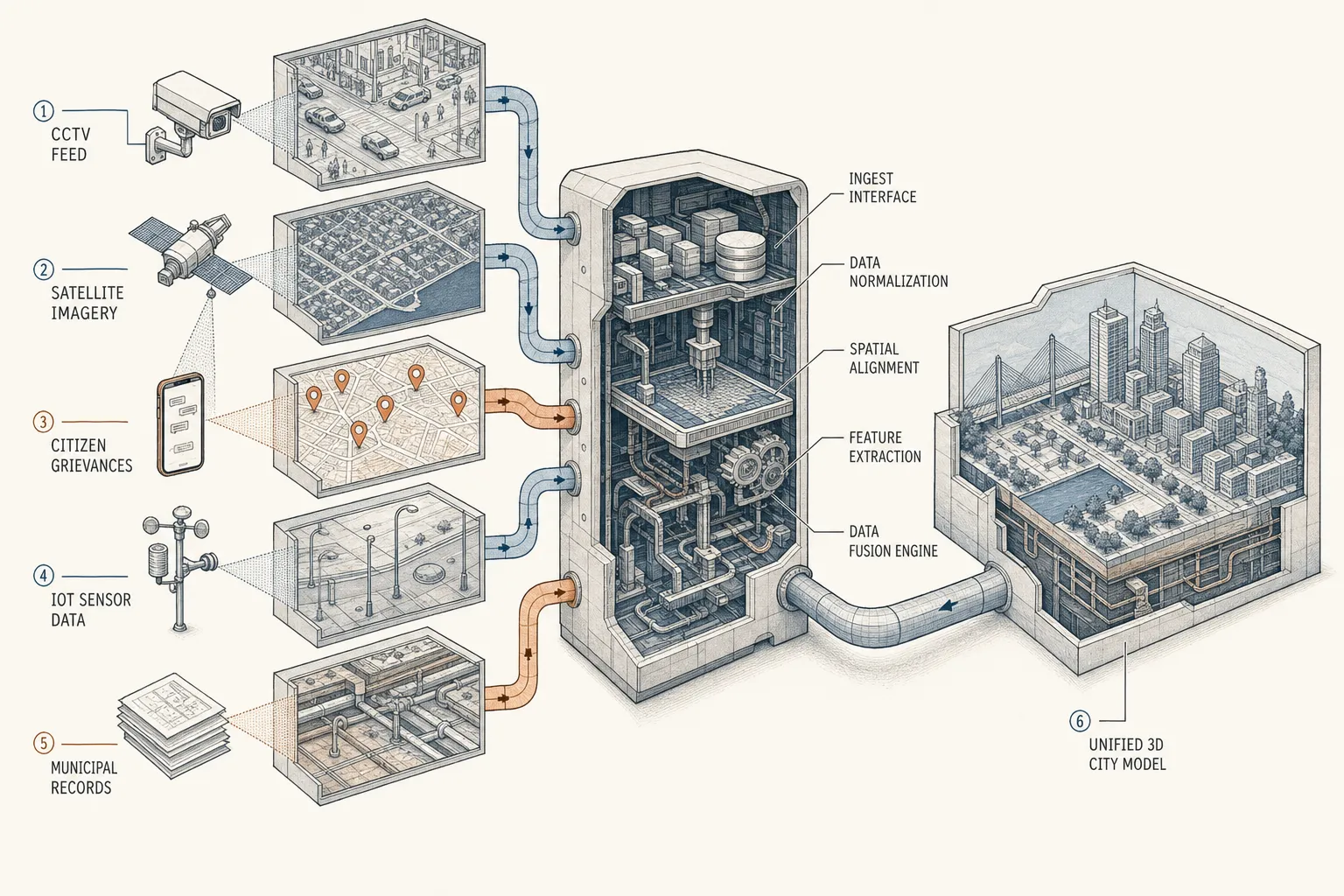
This shift becomes possible because the sources available to governments have fundamentally changed. CCTV provides continuous visual evidence. Drones and mobile cameras provide inexpensive reality capture. Satellite imagery provides repeated observation at scale. Computer vision can identify objects and changes. Vision-language models increasingly allow those observations to be translated into language and queried alongside conventional administrative data.
Documents, MIS systems, sensors, imagery, and video no longer necessarily have to remain separate universes. They can become different pieces of evidence about the same underlying entities:
- A road exists independently of the road database.
- A building exists independently of the property register.
- A garbage dump exists whether or not somebody has filed a grievance about it.
The interesting technological problem is therefore to continuously reconcile what the government records with what the world appears to contain—creating a continuously maintained state of the world.
From Information Retrieval to Decision Systems
Once that representation exists, another boundary disappears. Most government technology today is designed primarily to help humans retrieve information and execute workflows. Dashboards show things. MIS systems count things. Grievance systems route things. CCTV systems display things.
But if AI can reason over a sufficiently reliable representation of reality, the question changes from what happened? to what should we do?
Consider road maintenance. Detecting potholes from imagery is useful, but it is still fundamentally an observation problem. The more consequential system would understand road condition alongside traffic intensity, accident history, citizen complaints, rainfall, planned utility excavations, available budgets, contractor performance, and the history of previous repairs.
It could then ask: Given the resources available this month, which road segments should be repaired first? More importantly, it could explain why. And because the underlying evidence carries provenance and confidence, the recommendation does not have to emerge from an inscrutable black box. A decision-maker can inspect the evidence, change assumptions, override the recommendation, and record why.
observe → reconcile → understand → prioritize → recommend → act → measure
That is considerably closer to the actual function of government than another dashboard.
Two Learning Loops
There is an interesting symmetry between these systems.
-
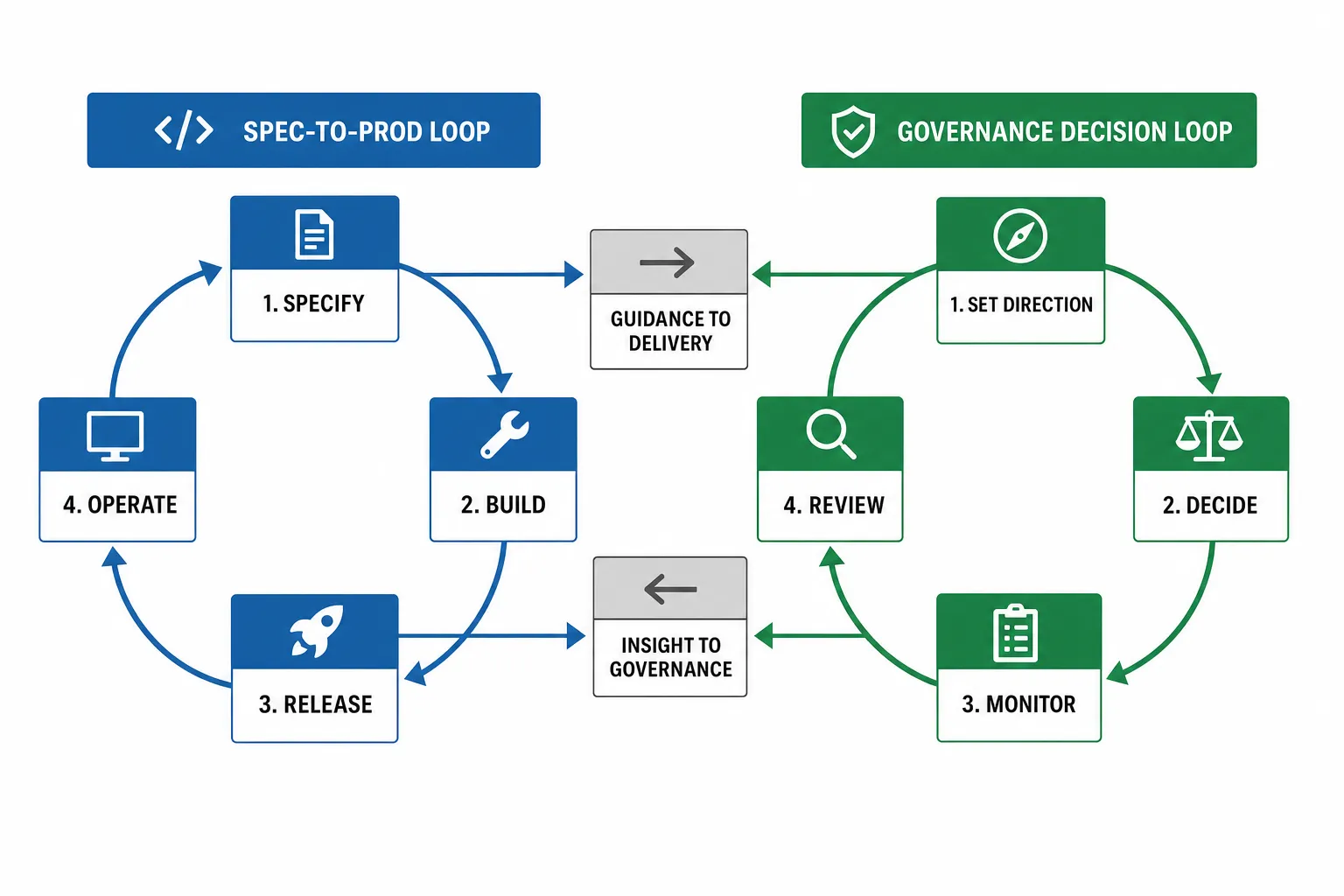
The software loop: A government expresses a requirement. Spec-to-prod produces an implementation. The constitution establishes what cannot change. Evaluation harnesses measure the resulting behaviour. Useful variations can eventually improve the underlying product.
requirement → spec → product → eval → improved product -
The governance loop: Data drivers observe and reconcile reality. AI identifies problems and proposes interventions. Humans make decisions. Government acts. Outcomes are measured. Those outcomes improve subsequent recommendations.
observation → foundational state → decision → intervention → outcome → improved decision
One loop learns how government software should work. The other learns how government should act.
The Products Become Interfaces
Grievances, properties, CCTV, and finance do not disappear—their role changes. They are no longer four independent products, each with its own isolated database and intelligence. They become different interfaces into the same underlying government operating environment.
A grievance is one observation about reality. A CCTV frame is another. A property transaction is another. A satellite image is another. A payment is another. A field officer’s inspection is another.
Once these observations can be reconciled around common entities—places, people, assets, organizations, events, and time—AI can begin reasoning across boundaries that traditional government software inherited from departmental structures.
Perhaps that is what remains to be built after software becomes easy to generate: not another generation of government applications, but an infrastructure through which governments can continuously observe, understand, decide, act, and learn.