
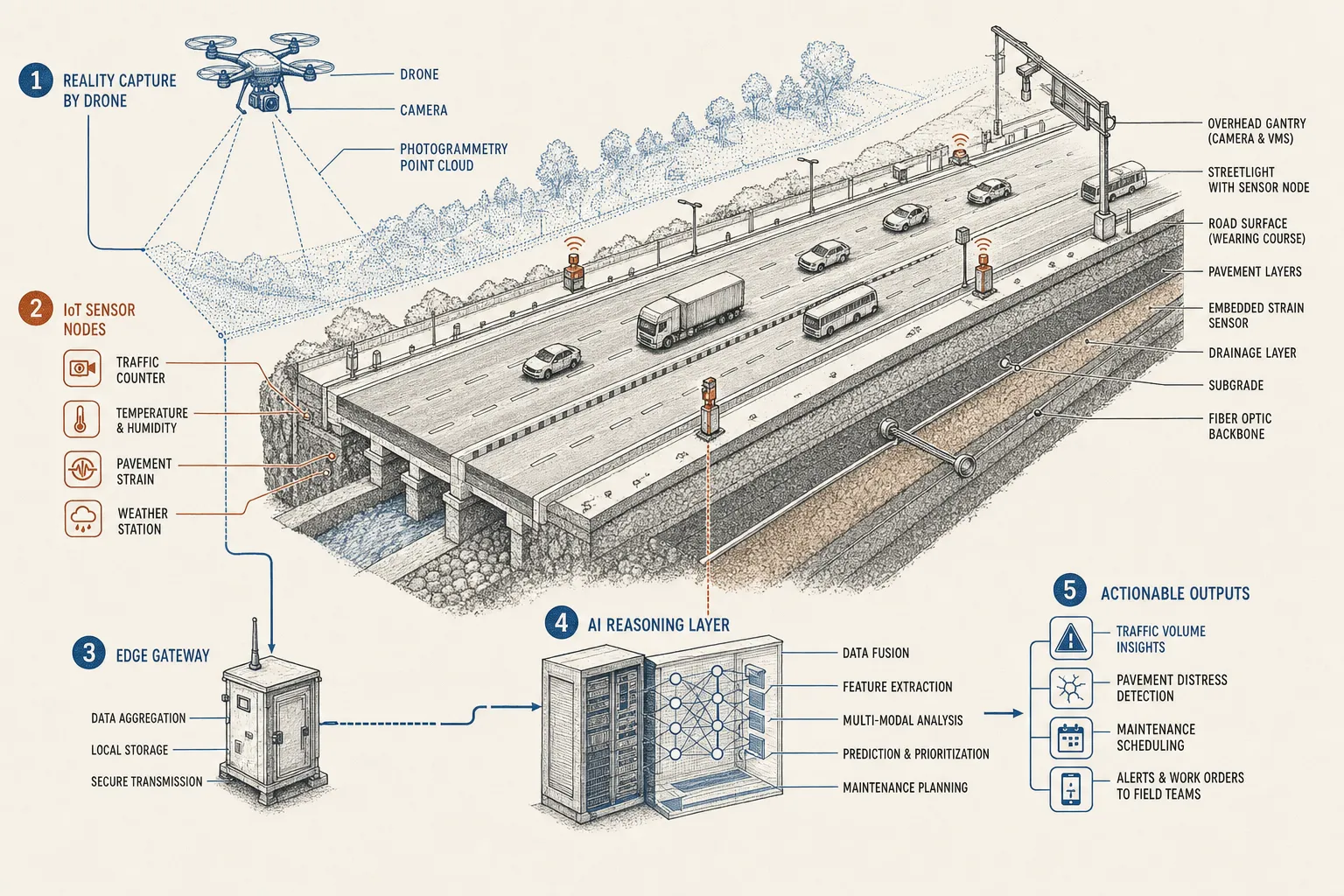
The state has acquired something close to continuous observation. Over the past decade, Indian public infrastructure procurement has proven surprisingly adept at adopting cutting-edge reality capture technology. Drones track highway construction progress on monthly schedules. Satellite imagery monitors corridor encroachments. Edge-AI cameras detect pavement distress and missing signage. IoT sensors log bridge tilt and culvert water levels.
Yet an administrative paradox has emerged: India has built world-class machinery for observing reality, but preserved the nineteenth-century decision architecture that determines what to do with what it sees. The inputs upgraded from physical inspection registers to high-resolution drone rasters, but the downstream workflow remained unchanged: periodic written reports, multi-tier file routing, human review, and static executive dashboards.
From Detection to Decision
The obvious next step is not more AI for detection. Automated pavement defect detectors that flag potholes or cracking are rapidly becoming commodity technology. When a road agency like the National Highways Authority of India (NHAI) receives monthly condition data across 50,000 kilometres of highway, anomaly detection simply yields a map peppered with 40,000 red dots.
The bottleneck shifts instantly from information scarcity to attention scarcity. The question facing a regional engineer is no longer "Where is the distress?" but "Which 200 interventions should we execute this month with our available budget?"
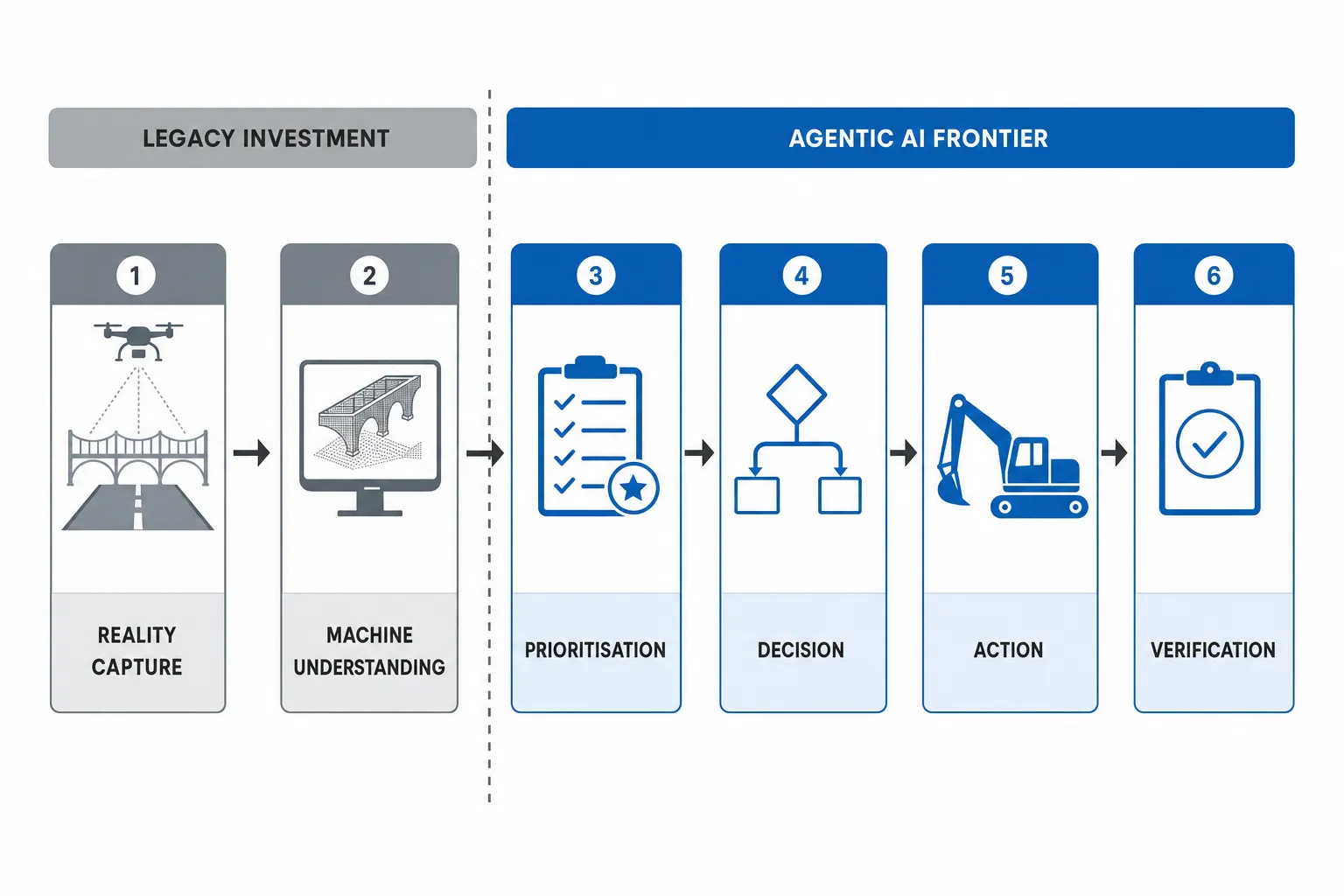
The progression of infrastructure intelligence follows six distinct stages:
Reality Capture → Machine Understanding → Prioritisation → Decision → Action → Verification
India invested heavily in the first two stages. The unaddressed frontier is everything that follows.
| Dimension | Legacy Paradigm ("Better Eyes") | Agentic Paradigm ("Better Judgement") |
|---|---|---|
| Primary Output | Anomaly maps (e.g., 40,000 red flags) | Ranked work plans (e.g., 73 prioritized interventions) |
| Reasoning Layer | Manual review across disconnected silos | Automated reasoning across weather, budgets & liability |
| Unit of Software | The Screen (Dashboards, GIS portals, E-files) | The Decision (Auditable, contextual proposals) |
| Bottleneck | Information scarcity | Attention scarcity |
What Reasoning Across Silos Looks Like
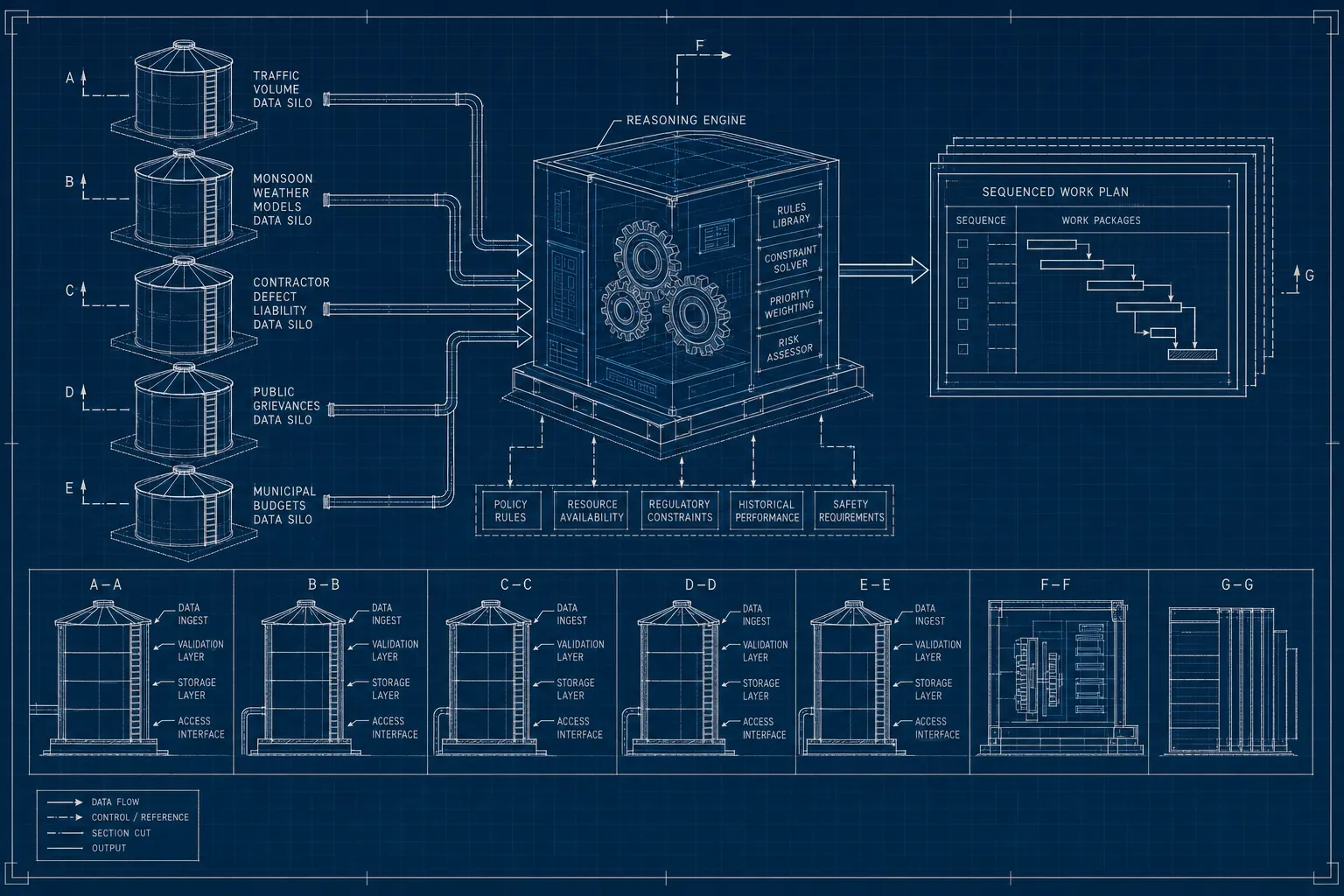
Agentic AI operates as a reasoning engine rather than a passive alert system. Instead of handing an official another GIS dashboard, an agentic system evaluates every detected flaw against the state's broader institutional knowledge.
Consider how an agentic layer processes an accelerating pavement distress signal. It cross-references:
- Historical deterioration rates from previous drone passes
- Heavy vehicle traffic volume records
- High-fatality accident corridor maps
- Impending monsoon weather forecasts
- Active contractor defect-liability obligations
- Nearby civil works and drainage maintenance schedules
- Unresolved public grievances and available zonal budgets
Instead of presenting 40,000 red dots, the agent synthesizes a ranked work plan:
"73 highway stretches require intervention within the next 90 days. 11 exhibit accelerating sub-base degradation; 17 overlap with high-fatality corridors; 8 face imminent drainage overflow before monsoon; 22 remain under contractor defect-liability periods and can be repaired at zero state cost. Executing this sequence yields the highest expected risk reduction for the available ₹45 crore budget."
Crucially, the agent explains its chain of thought, allowing a senior administrator to audit its assumptions, adjust parameters, and approve action with confidence.
The Dashboard as Intermediate Technology
The dashboard was an intermediate technology of the early web era. Twenty years of government digitisation converted paper into code without redesigning the underlying organizational structure.
- Registers became SQL databases.
- Reports became interactive dashboards.
- Files became e-files.
- Field inspections became drone surveys.
The interface changed, but the decision architecture endured. Generative and agentic models create the possibility that the fundamental unit of government software stops being the screen and starts being the decision.
The unit of government software must stop being the screen and start being the decision.
In a nation with over 4,000 urban local bodies, hundreds of thousands of kilometres of roads, vast water networks, and millions of public assets, senior administrators face acute cognitive overload. A District Collector should not have to navigate six disconnected dashboards to understand infrastructure health. She should be able to query: "What are the five infrastructure vulnerabilities in my district most likely to cause a critical failure in the next six months?"
The system assembles evidence, quantifies uncertainty, weighs constraints, ranks interventions, and links directly down to underlying imagery or contractual records.
An Intelligence Layer Over Digital Exhaust
Government procurement remains trapped in buying closed systems. Agencies routinely issue tenders for discrete software verticals: a GIS portal, a drone survey package, a grievance management system, an ERP, or an AI analytics platform. Each brings its own proprietary schema, vendor lock-in, isolated database, and multi-year contract.
Agentic AI requires a fundamental shift in procurement logic. It does not need to own the drone fleet, the satellite feed, the weather model, or the asset register.
The opportunity is not to build another AI dashboard, but to construct a reasoning layer over the state's existing digital exhaust.
This intelligence layer requires only read-and-reason permissions across existing data streams. It bridges the gap between disparate software investments made over the past decade.
From Better Eyes to Better Judgement
The last decade was spent building the state's eyes; the next must be spent building its judgement. State capacity is not measured solely by how rapidly a government can record reality, but by how effectively it converts perception into timely, defensible action. As agentic AI matures, the competitive advantage of public administration will belong to governments that bridge the gap between seeing reality and changing it.