

For most of its history, advertising has tried to answer increasingly sophisticated versions of the same question: who is likely to buy this? Multimodal AI introduces a more consequential possibility: what if the machine can begin to model not just what we buy, but how we make choices—and eventually use that model to recommend, persuade, or act?
A small experiment recently made me think differently about the future of advertising.
I began with something almost trivial: I showed an AI a photograph of a couple and asked what, if anything, it could infer about them socially. Not their actual income. Not their intelligence. Not whether they were good at their jobs. I was interested in the much fuzzier phenomenon we all experience when meeting someone: the way we form an immediate impression that a person is successful, comfortable, ambitious, formidable, conventional, creative, or socially confident.
The model was appropriately cautious. From a photograph, it could describe presentation—clothing, posture, apparent formality, ease in front of the camera, visual cues associated with certain professional or social environments. But it could not legitimately determine intelligence, upbringing, professional ability, or wealth.
Then I gave it more information: I showed it the couple's Instagram grid. The feed contained international travel, weddings, friends, couple photographs, beaches, restaurants, and social occasions. The model tentatively interpreted the feed as socially oriented and conventionally polished. Many of the photographs were about people in places: we went here, we celebrated this, we were together.
I later added that they worked in management consulting. That contextual information made some of the earlier visual signals easier to interpret, but it was important not to reverse the logic. The photographs had not somehow discovered their jobs; at best, they had produced a set of weak hypotheses that became legible once additional context was supplied.
Then I showed the model my own Instagram grid. It contained more photographs of architecture, books, craft, objects, clothing, interiors, historical sites, food presentation, unusual visual details, and portraits. Sometimes I was in the photograph. Often I wasn't.
The model summarized the contrast, perhaps a little too neatly:
"Their feed documents experiences; yours editorialises experiences."
That is not a judgment of quality, sophistication, or intelligence. It is simply a useful shorthand for two different patterns of curation:
- One feed appeared to repeatedly select people, events, and destinations.
- The other appeared to repeatedly select objects, visual details, historical texture, and composition.
That distinction may say something meaningful about preference, or it may reflect how each person uses social media. A feed is curated, not a transparent window into personality. But that is precisely what made the experiment interesting: even if two people look similar to a conventional advertising system, a multimodal model can begin distinguishing what repeatedly receives their attention.
A Century of Moving Closer to the Individual
At a high level, advertising has evolved through three distinct information regimes.
| Era | Fundamental question | Primary data | Unit of understanding | Typical inference | What gets predicted | Personalization | Valuable resource | Central weakness |
|---|---|---|---|---|---|---|---|---|
| Traditional advertising | Who are you? | Age, gender, income, geography, media habits | Demographic or psychographic segment | “Affluent urban professionals may want this” | Group propensity | Message by audience | Distribution | Crude grouping |
| Digital advertising | What did you do? | Searches, clicks, likes, purchases, follows, dwell time | Interest, intent or audience segment | “This user searched for Morocco hotels” | Next action or conversion | Placement, timing, retargeting, creative | Attention + behavioural data | Behaviour without explanation |
| AI-native advertising | How do you appear to choose? | Language, images, choices, rejections, context, conversations | Probabilistic individual decision model | “This person often prefers historical properties to standardized luxury” | Context-dependent preference | Product, ranking, argument and action | Decision context + trust | Over-inference, manipulation, conflicts of interest |
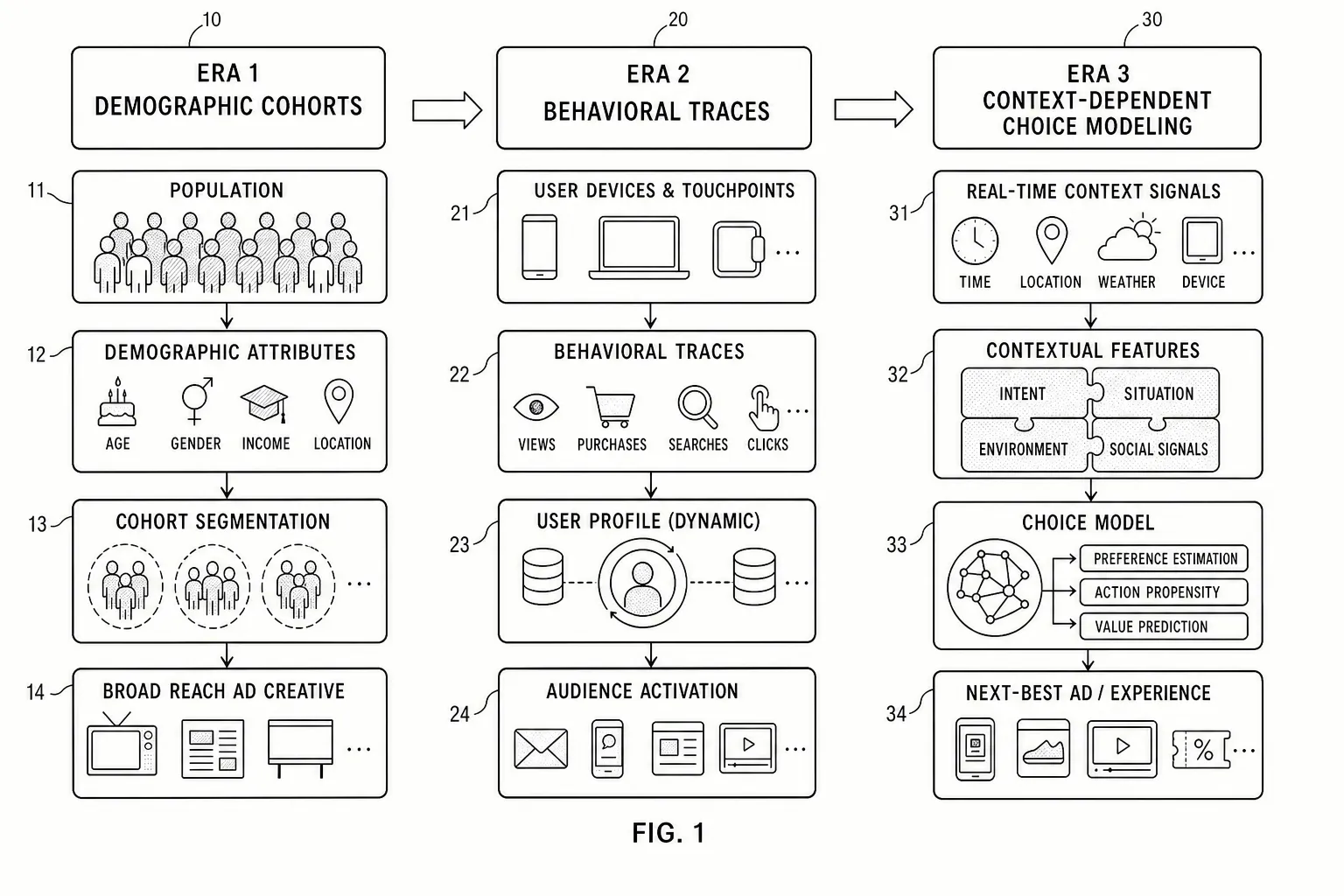
The transition is important because each generation observes something the previous one could barely see. Traditional advertising observed populations. Digital advertising observed behaviour. AI may increasingly interpret the semantic relationship between behaviours.
Advertising 1.0: Who Are You?
Traditional advertising was, in large part, probabilistic sociology. A company selling an expensive watch could not know individual consumers particularly well, so it found populations statistically likely to contain them: business press, fashion magazines, television inventory around affluent programming, and billboards in specific neighbourhoods.
Over time, demographics were supplemented by socioeconomic classifications, lifestyle segments, psychographic systems, brand affinities, and consumer archetypes. The basic logic remained: find people who resemble the kind of people who buy this. The system knew something about the group, but relatively little about the individual.
That limitation shaped creative strategy. A luxury-car advertisement could not produce a unique argument for every buyer. It needed an argument capable of working across an entire segment: achievement, freedom, safety, status, family, performance. The advertisement was a compression of a market's presumed psychology.
Advertising 2.0: What Did You Do?
The internet changed the observation layer completely. Google no longer needed to infer from your demographic profile that you might be planning a trip to Morocco. You could type: Morocco weather November. Intent had declared itself.
Then behavioural data exploded: search queries, clicks, website visits, cookies, shopping carts, purchases, likes, follows, shares, video completion, scroll speed, dwell time, location, social graphs, and app behaviour.
Digital advertising moved from estimating who you were to observing what you were doing:
- Google captured declared intent.
- Social platforms captured interests, identity, and relationships.
- Amazon captured transactional behaviour.
- TikTok pushed the system further toward attention through video dwell time.
The industry moved through a distinct progression: identity → interest → intent → behaviour → attention.
And yet even sophisticated behavioural systems face a fundamental limitation: they know that you clicked, but they do not know why.
The Missing Variable Is Interpretation
Imagine two people who both spend heavily on hotels. To a conventional database, they look identical: frequent international travellers, premium hotel spend, high travel propensity, luxury hospitality interest.
But they may have completely different decision functions:
- One values predictability, service quality, large rooms, convenience, and standardized comfort.
- The other values architecture, historical character, local materials, eccentricity, and visual distinctiveness.
The transaction looks identical; the motivation diverges. That distinction matters because their next hotel choice will diverge sharply. Digital advertising learns correlations between past and future actions. Multimodal AI begins to infer the structure producing the behaviour.
What You Notice Is Behavioural Data
Traditional image classification might detect travel, fashion, architecture, food, Europe, wedding, beach. Useful, perhaps, but those categories discard the richest signal.
A photograph is not merely an image of an object; it is the residue of a decision. Out of everything present in someone's visual field, this was selected.
A person visits an old hotel. She could photograph the pool; she photographs the staircase. She could photograph herself at dinner; she photographs the ceramic plate. She could photograph the landmark; she photographs the shadow falling across the old stone wall.
One photograph tells us almost nothing. Hundreds of choices begin to reveal selection behaviour. The same holds true across digital footprints: Pinterest boards, Spotify playlists, Kindle libraries, camera rolls, wardrobes, browser histories, saved restaurants, unpurchased shopping carts, rejected hotel shortlists, forwarded articles, and screenshots saved without comment.
Multimodal models are closing the gap between storing these traces and interpreting their semantic relationship.
Language Changes the Quality of the Data
Images may tell a system what receives attention, but language reveals why. And conversation provides something even more valuable: correction.
Meta's recent announcement that interactions with Meta AI will be used to personalize content and ads across its apps confirms that major platforms are already turning conversational data into recommendation signals.1 The critical question is what happens as those interactions reveal not just superficial interests, but explicit intent, trade-offs, and negative preferences.
During my experiment, I repeatedly corrected the model. I was not asking whether someone looked rich. I meant something subtler:
- Could you distinguish between conventional professional success and unusual individual distinction?
- Could you tell whether someone seemed socially comfortable without claiming to know whether they were intellectually sharp?
- Could different Instagram feeds reveal differences in curation without turning those differences into judgments of worth?
Each correction narrowed the interpretation. This is exactly what happens when people use conversational AI for real decision-making: "Too generic." "More understated." "I care about the architecture, not the pool." "Don't optimize purely for price."
Those statements contain far more information than a click.
Learning from Negative Preference
The old internet knows a lot about what we accept. AI learns from what we reject.
Digital systems have accumulated enormous amounts of positive behavioural data: clicked, liked, watched, purchased, followed, booked, shared. But preferences are often defined just as strongly by their boundaries:
- What do you consistently reject?
- Which apparently suitable options fail?
- What trade-off breaks the decision?
- Which attributes sound attractive in theory but never survive actual comparison?
Conversational AI observes negative preference directly. Suppose I show you fifty hotels, and over the course of a conversation you reject forty-nine: too modern, too far away, too generic, beautiful rooms but no sense of place, interesting design but poor reviews for noise.
The system has learned the boundary conditions of your taste—a signal far more predictive than knowing which travel posts you clicked six months ago.
From a Customer Segment to a Model of Judgment
A conventional advertising profile looks like: Female, mid-thirties, metropolitan India, professionally employed, internationally mobile, fashion interest, technology interest, premium-consumption propensity.
A digital system adds: researched Morocco, watched Marrakech videos, visited hotel booking sites, follows design accounts, purchased international flights, spends above average on hospitality.
A multimodal and conversational system tests context-dependent hypotheses:
- Often prefers distinctive environments over standardized ones.
- Historical texture appears more important than conventional luxury signals.
- Will pay more for design differentiation, but not simply for a famous brand.
- Architecture influences leisure-travel decisions disproportionately.
- Convenience dominates during work travel.
- Social proof matters more when travelling with a group than when travelling alone.
Over thousands of interactions, the representation shifts mathematically:
moves increasingly closer to:
The equations look similar, but the philosophical shift is substantial: one models customer cohorts, while the other begins to model individual decision-making.
The LinkedIn Layer: Cross-Domain Relational Intelligence
Adding LinkedIn introduces an entirely different source of information. Instagram contains visual selection; LinkedIn contains explicit professional information: education, entrepreneurship, product leadership, institutional affiliations, press coverage, and writing.
The value lies in making the relationship between datasets interpretable:
- Does this person's taste in travel correlate with how she evaluates software products?
- Does someone who repeatedly selects unusual visual details also favour distinctive product design?
- Does professional context suppress those preferences?
- Does reliability dominate in enterprise software while aesthetics dominate in hospitality?
Multimodal behavioural modelling asks not merely what categories belong to the same person, but under what conditions different preferences become dominant.
Human Beings Are Not Fixed Preference Vectors
Simplistic AI personalization will fail because people are not fixed preference vectors. The same person might prefer a 200-year-old riad in Marrakech for a holiday and a predictable chain hotel beside an airport before an early meeting. She may want unusual independent fashion for a party but conservative tailoring for a government presentation.
A crude model says: inconsistent consumer. A more sophisticated model says: different contexts activate different priorities.
The real frontier is not AI discovering who you "really" are, but AI estimating which preferences matter under which circumstances.
Personalizing the Argument, Not Just the Audience
Digital advertising decides who sees what, where, and when. Multimodal AI adds: why should this particular person care?
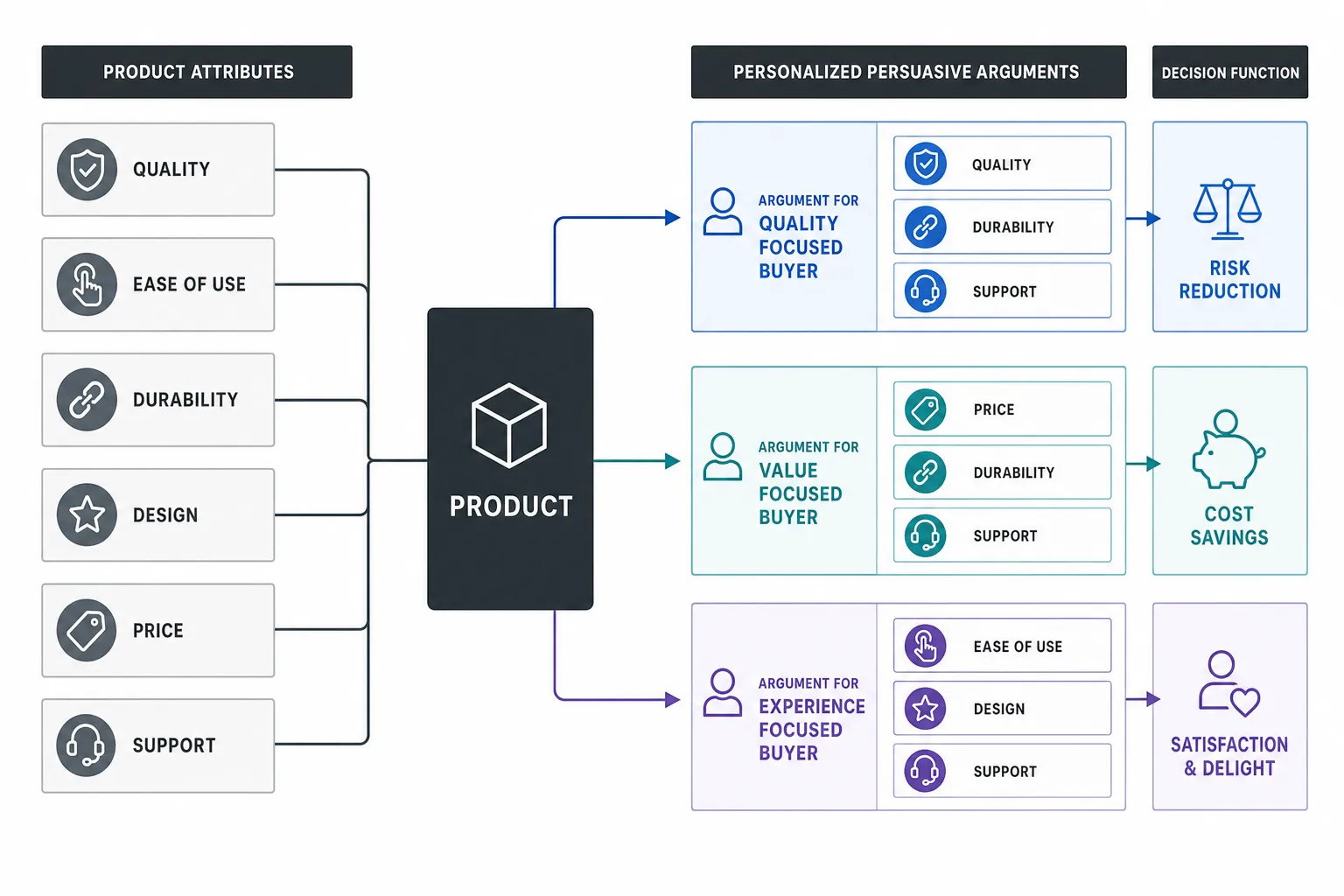
Consider a watch with ten legitimate attributes: heritage, movement engineering, design, craftsmanship, scarcity, celebrity association, resale value, status, cultural history.
- Traditional advertising selects a brand position and emphasizes it across a segment.
- Digital advertising identifies users likely to respond.
- AI-native advertising chooses the persuasive pathway itself.
For one person, the relevant argument is status; for another, movement architecture; for another, historical design continuity; for another, scarcity. Same product, same underlying facts, different reason to care.
That is more than personalized targeting. It begins to look like personalized persuasion.
The Information Architecture of Persuasion
Imagine a hotel with twenty selling points. Conventional advertising must decide which features define the campaign. A personal model knows that a traveller repeatedly photographs buildings, has rejected standardized luxury, and asks who designed a property.
The advertisement for that person barely mentions the pool. Instead it emphasizes: Designed around the original landscape, using local materials, with interiors developed around regional craft traditions.
Nothing about the hotel changed. What changed was the information architecture of persuasion—selecting truthful reasons tailored to one person's decision function.
Recommendation vs. Advertising
Bad advertising announces itself (BUY THIS). Digital retargeting is subtle (You looked at this yesterday). AI-mediated commerce feels entirely different: "I've compared 180 hotels against your preferences. These three seem strongest."
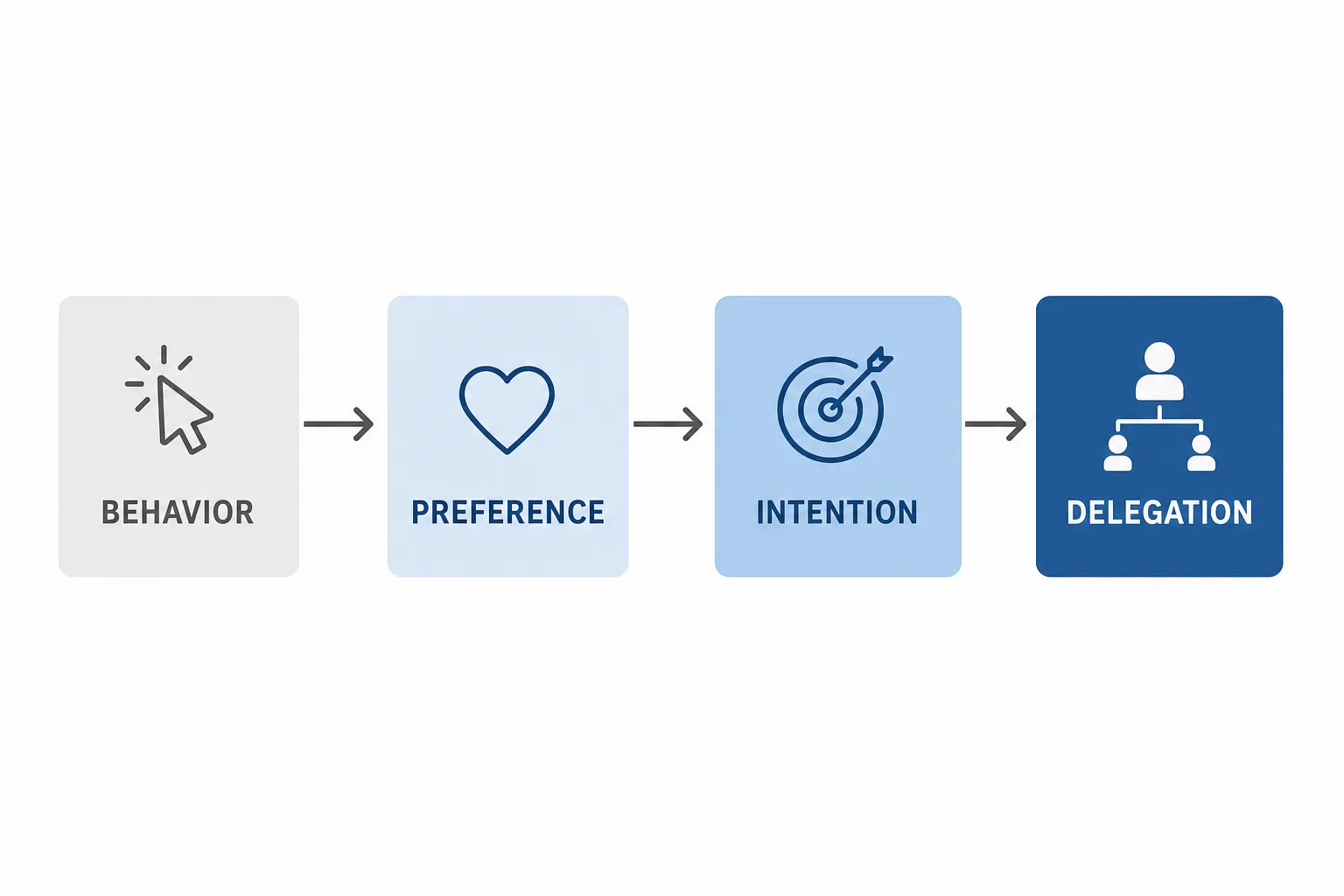
This transition is already visible in conversational commerce. OpenAI's work on powering product discovery in ChatGPT explicitly addresses shopping based on a user's budget, preferences, and situational constraints.2 It maps neatly to a four-stage framework: behaviour → preference → intention → delegation. The user is no longer typing keywords into a box; they are delegating the evaluation of complex constraints to an assistant.
That sounds like advice. But suppose the second hotel paid the platform to rank higher, or the system selected an argument to overcome a price concern.
The key question shifts from Was this targeted advertising? to Was this recommendation independent?
Commercial influence can affect three distinct levers:
- Ranking
- Consideration set
- Explanation
Users will need transparency into all three, because the most powerful advertisement imaginable may look like excellent advice.
When Agents Enter the Market
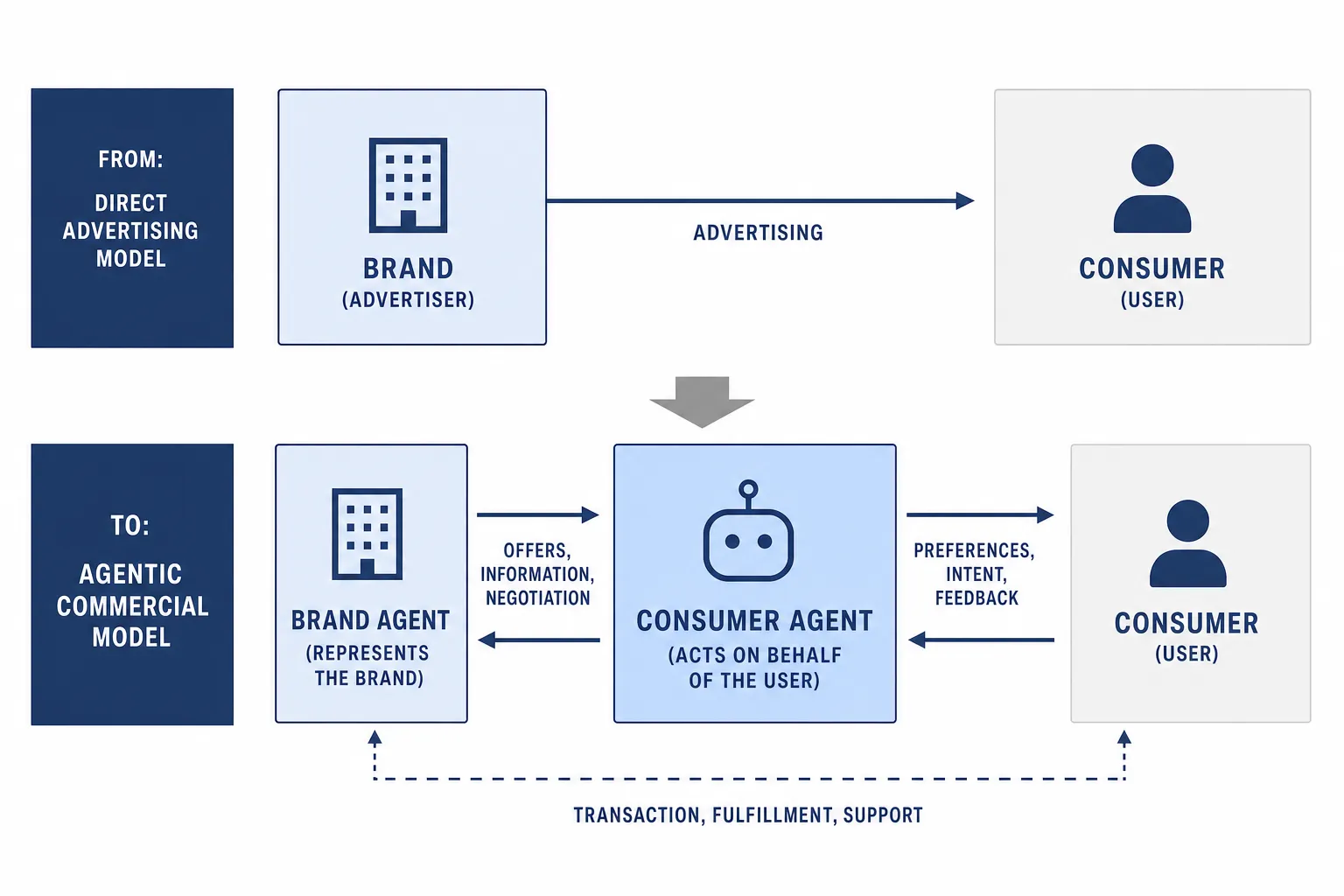
Now imagine the user says: "Find me somewhere memorable to stay in Marrakech. ₹25,000–40,000 a night. Architecture matters. Central location matters."
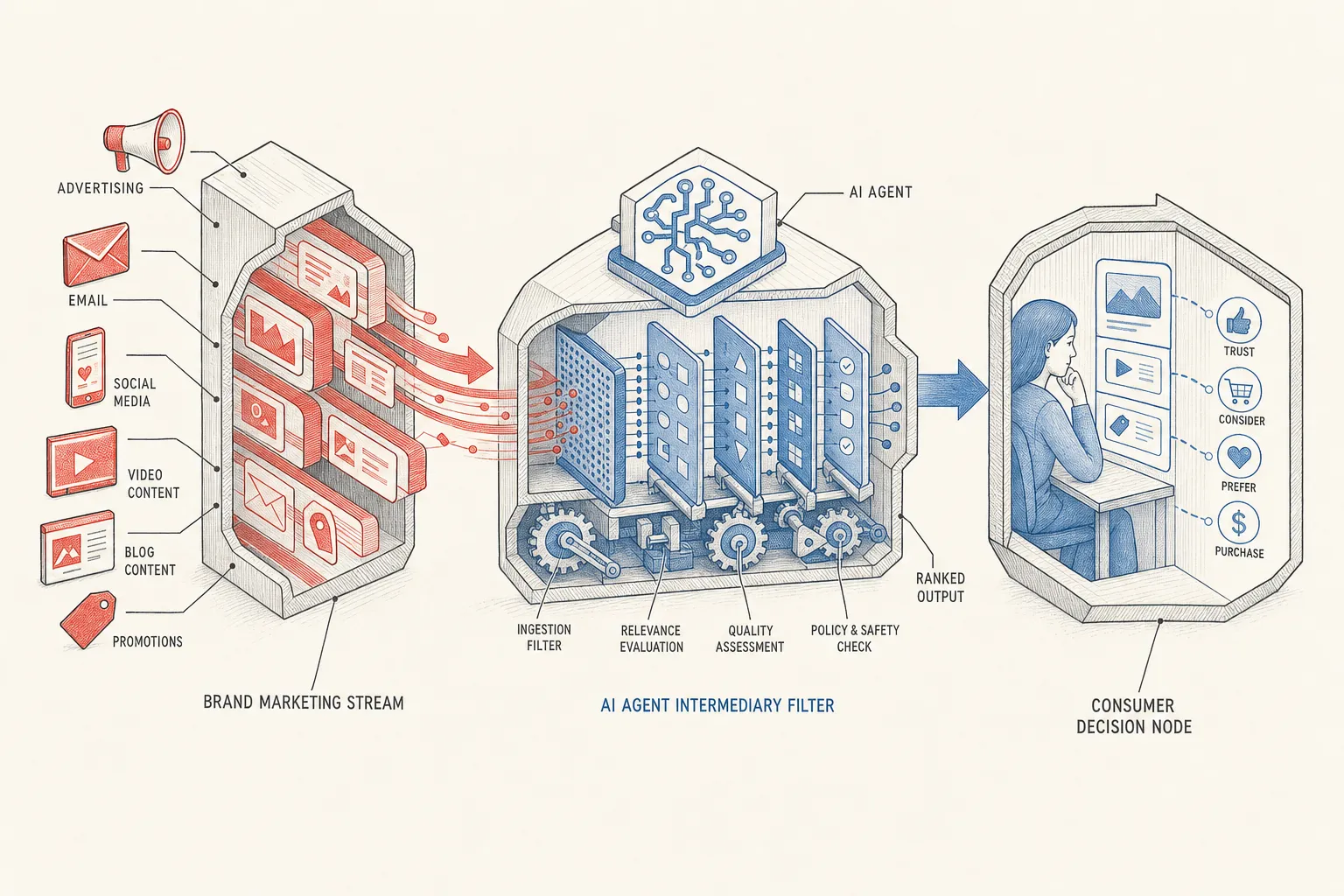
The agent searches hundreds of properties. At that point, who is the hotel advertising to? Not only the person, but increasingly the person's agent.
Amazon Ads recently highlighted this shift, framing the central challenge for brands as learning to connect with customers who are shopping alongside AI agents.3 In their framing, brands must now address an AI assistant that has already researched, compared options against user constraints, and formed a top recommendation before the human shopper ever sees the product.
The commercial architecture shifts:
toward:
and eventually:
SEO Evolves into Preference-Model Optimization
The internet spent decades learning how to become legible to search engines. Agentic commerce creates another audience: machine decision-makers acting on behalf of humans.
A hotel will need machine-readable data about noise levels, architect, room dimensions, historical provenance, cancellation rules, mattress type, and dietary options. A consumer's AI does not need "LUXURY REDEFINED." It needs enough structured data to evaluate match quality.
Marketing moves from rhetoric toward legibility. Part of the advertisement effectively becomes an API. Generic branding ("premium," "world-class," "innovative") weakens because models demand evidence. AI commoditizes vague branding while making authentic, verifiable differentiation more valuable.
Decision Proximity: The New Scarce Resource
The economics of advertising can be read through what was scarce in each era:
Mass media competed for distribution. Search competed for intent. Social media competed for attention. E-commerce competed for transaction proximity. AI assistants introduce a new scarce position: decision proximity.
Who is present when the user says: Help me choose?
That intermediary sits inside the decision process itself, possessing present intention, contextual constraints, rejected alternatives, and historical decision patterns.
The Risk: From Recommendation to Manipulation
There is an enormous difference between understanding someone's preferences to find what they want and understanding them to exploit their psychological vulnerabilities.
Suppose a system learns that one individual responds to scarcity, another to social proof, another to status, another to FOMO. A sufficiently capable AI could deploy the specific persuasive lever that maximizes conversion for that specific person.
This is where personalization turns into manipulation. Privacy rules alone cannot govern this; we will need governance around commercial ranking bias disclosure, explanation transparency, and delegation limits.
The Evolution of the Advertising Machine
| Era | Scarce information | Core question | Commercial advantage |
|---|---|---|---|
| Mass media | Audience access | Who might want this? | Distribution |
| Demographic targeting | Audience characteristics | Which kind of person wants this? | Segmentation |
| Search | Declared intent | What does this person want now? | Intent |
| Social | Identity + interest | What captures this person's attention? | Attention |
| Commerce | Purchase behaviour | What is this person likely to buy? | Transaction data |
| Multimodal AI | Semantic behavioural context | How does this person appear to choose? | Preference modelling |
| Agents | Context + authority | What should I choose for this person? | Decision proximity |
| Autonomous agents | Trust + permission | May I act on their behalf? | Delegation |
For more than a century, advertising has tried to become better at influencing our decisions. The most powerful commercial interface ever built may instead be the one we voluntarily ask: Given what you know about my preferences, constraints, and previous choices, what do you think I would choose?
If the system answers entirely in our interest, it is an adviser. If commercial incentives influence the answer, it is advertising. If it can make the decision for us, it is an agent.
And if we cannot tell which of those roles it is playing at any given moment, then the problem is no longer simply the future of advertising—it is the future of trust.
Footnotes
-
Meta Newsroom, Improving Your Recommendations on Our Apps With AI at Meta (2025-10-01). ↩
-
OpenAI, Powering Product Discovery in ChatGPT. ↩
-
Amazon Ads, How to connect with customers shopping with AI agents. ↩