
Hospitality has spent decades perfecting the middle of the journey. The check-in is smoother, the linen is better, the breakfast spread has grown. But the industry still treats the stay as the entire product, when the two most valuable phases of a guest's journey happen outside it: the anticipation before arrival, and the memory after departure. Both are almost entirely unmonetized, and both are now cheap to capture.
Before arrival: turn the pre-order burden into concierge behavior
Smaller properties and homestays have a known friction. Kitchens need meal orders 24 hours in advance. Today this is presented as a chore the guest performs for the kitchen's benefit—a form, a phone call, a WhatsApp message that goes unanswered until someone chases it.
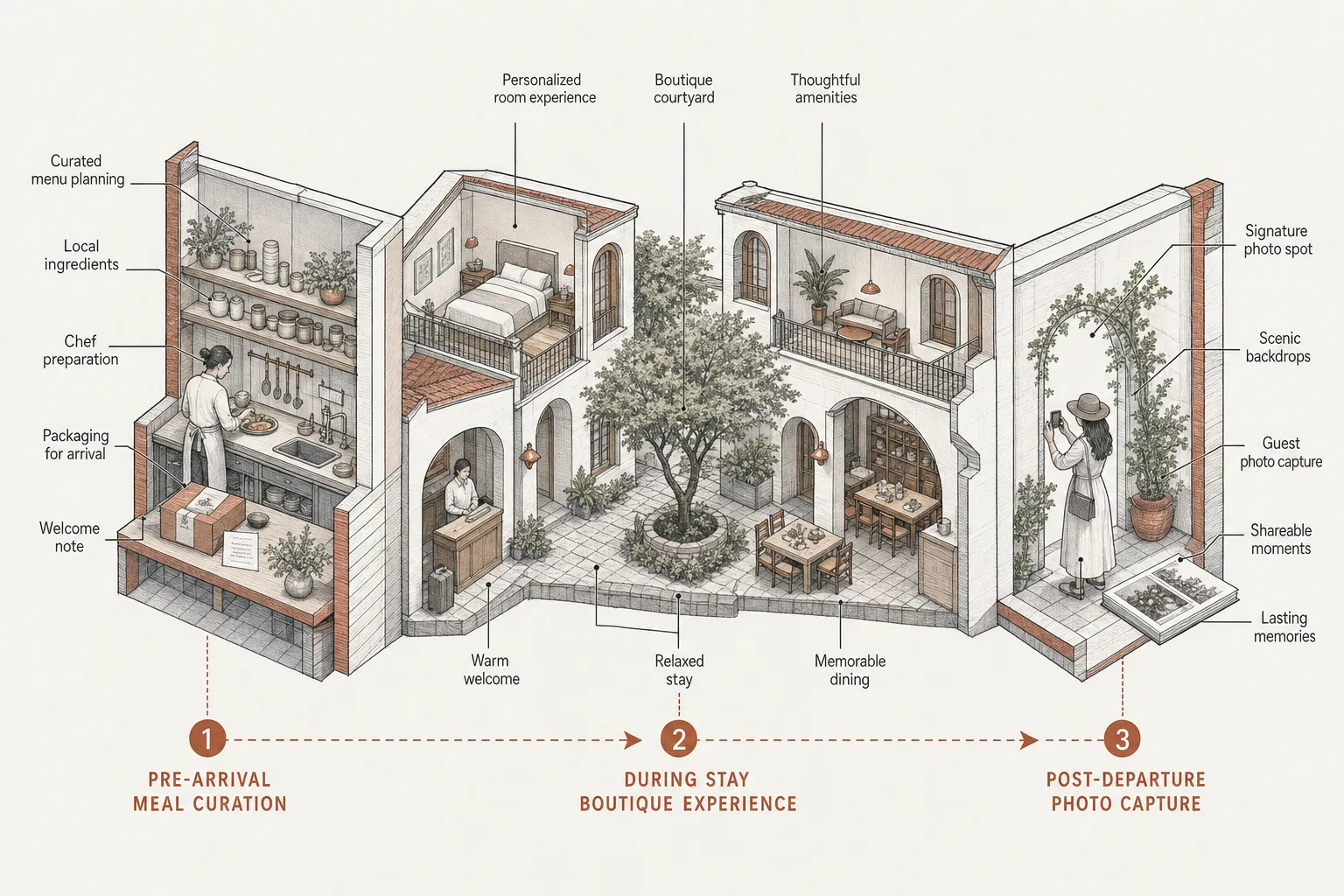
AI collapses this friction into a feature. A network of properties has differing cuisines, local specialties, and kitchen constraints. A two-minute conversational exchange a few days before arrival—veg or non-veg, spice tolerance, anything you're excited to try locally—is enough to generate a curated meal plan for the entire stay, matched to what each property actually does well. The guest arrives and their meals are already decided, already anticipated, already waiting.
The reframe matters. "Please order 24 hours in advance" is a burden. "Your meals are curated and waiting" is a concierge. Same constraint, opposite emotional register.
The secondary effects are where the economics live. Pre-committed orders raise food and beverage attach rates, because people order more when it is frictionless and anticipatory rather than a decision made hungry and tired at 9pm. The kitchen gets demand certainty, which cuts waste, a real cost line at small properties. And across a network, the taste profile becomes portable: the guest who told you once never has to tell you again. That accumulated preference graph, not any single menu, is the durable asset.
After departure: the review problem is a timing and currency problem
Every operator knows the pattern. The moment a guest steps away, they stop caring about you. Getting them to remember to leave a review is notoriously difficult. Discount codes have been tested and they work poorly, because they price the relationship. The ask becomes transactional, and transactional asks feel cheap.
The fix is to change the currency. The most valuable artifact of any trip is the photographs, and most guests leave with a camera roll full of mediocre ones. So the property should own the photo layer.
Designate a small set of camera spots across the property. Not closed photobooths, but open, pre-staged locations chosen obsessively for light and framing. Guests follow a checklist of spots, trigger the capture themselves, and receive a set of edited, ready-to-post images a day or two after checkout, precisely when post-trip nostalgia peaks. Some spots carry season-specific decor, so repeat guests and repeat seasons always have fresh supply.
Now the post-stay message is a gift rather than an ask. The review request rides along with the gift rather than as a condition of it. That is reciprocity, not transaction, and reciprocity converts where coupons do not.
The spots do double duty. A checklist gamifies exploration of the property itself, and guests who have engaged more deeply write better reviews independent of the photo delivery. And every image posted with a geotag is user-generated marketing that no OTA spend can buy.
Two design constraints are non-negotiable. Capture must be guest-triggered, never always-on; always-on cameras at a homestay are a privacy story waiting to happen, and they produce bad photographs anyway. And quality is the entire product: a fixed camera at a badly lit spot delivers images worse than the guest's own phone, and the gift falls flat. Three spots staged perfectly beat ten spots covered adequately.
The larger point
Neither idea requires new hardware to test. A conversational pre-order flow and three well-staged photo spots with a QR code can be piloted at a single property in a weekend. What they require is a shift in framing: the stay is the middle of the product, not the whole of it. The properties that win the next decade of independent hospitality will be the ones that own the anticipation and the memory, because that is where loyalty is actually manufactured.