

Years before ChatGPT could turn a collection of half-formed thoughts into a polished paragraph, UMass anthropology professor Arthur Keene gave his freshmen a piece of advice:
The single best predictor of success after college is how well you write. Not your GPA. Not your degree. How well you write.
Keene’s prescription was equally uncomplicated: write more. Take courses that force you to write, find people who will critique you, and, if you aren’t good at it, go to the writing center.
Which makes the recent controversy at Harvard particularly interesting.
In The Atlantic, Tyler Austin Harper writes about Harvard’s decision to dismantle its Writing Center and lay off its director, Jane Rosenzweig. Harvard is tightening its belt amid a reported $365 million budget shortfall. There are perfectly reasonable conversations to be had about administrative bloat at elite universities.
But Harper asks, in effect: why must the belt-tightening begin here? Why writing, and why now?
The question has stayed with me because a surprisingly large part of my own job is writing. I work with AI and technology, but much of the actual work isn’t technological at all. It is structuring chaos.
Before anyone builds anything, somebody has to make sense of it. There is an ambiguous problem, five versions of reality, noisy data, institutional constraints, technologies that can do some things but not others, and people who understand different fragments of the whole. And, very often, I make sense of it by writing.
I remember my first poems. Later, my first business plans. Today it might be a product note, a proposal, an argument about how a system should work, or an attempt to explain something that I understand intuitively but cannot yet articulate.
The late Harvard Business School professor Clayton Christensen apparently had a similar relationship with writing. A colleague remembered him saying that he never quite knew how complicated something was until he tried to write about it. Writing was what allowed him to untangle the complexity.
That description feels much closer to what writing actually does for me. Except now there is AI. And I write with it constantly.
The Seductive Competence of AI
There are days when this feels like a superpower. I can throw a page of disjointed observations at a model and watch it find a structure that might have taken me hours. Sometimes it puts into words something I knew but had not managed to articulate even to myself. That is genuinely useful.
Then there is the other experience. The model produces something that is almost what I wanted to say. The argument is sensible. The prose is clean. There is nothing obviously wrong with it. But somehow it isn’t quite my thought.
And because it is good enough, the lazy brain lets it pass.
Writing is not simply the final transcription of a fully formed thought. The page is where the thinking happens.
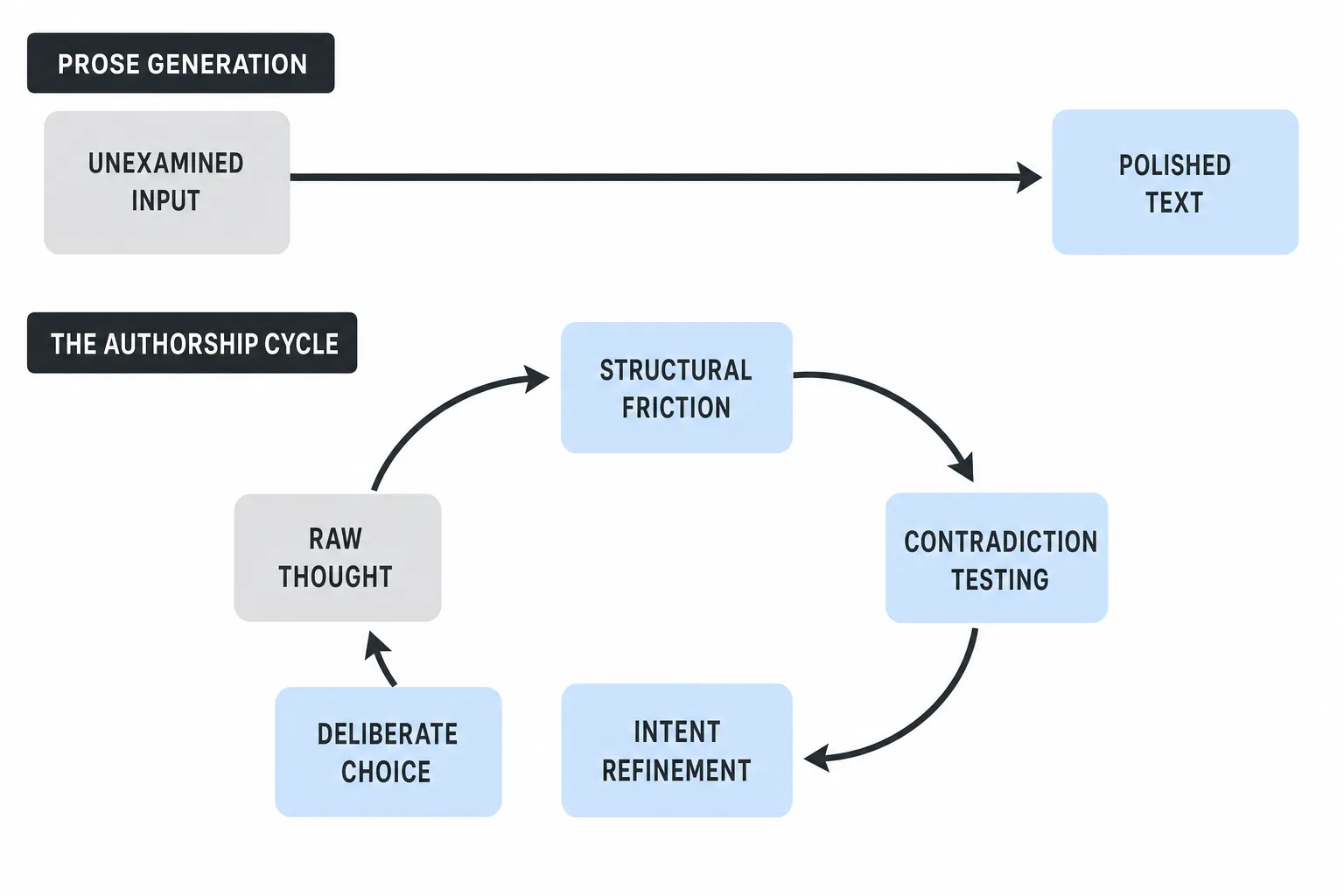
That, increasingly, seems to me like the more interesting risk of AI-assisted writing. It isn’t that AI will make us stop writing. It is that AI allows us to produce finished writing without necessarily completing the thinking that writing used to require. Those are not the same thing.
Anyone who has struggled with a blank page knows that writing is not simply transcription. You begin writing because you think you know what you mean. Three paragraphs later, you discover that you don’t. An argument doesn’t follow. Two ideas you thought were compatible contradict each other. A word feels wrong. You move a paragraph and suddenly realise that the thing you considered incidental was actually the point.
You rewrite. And somewhere in that slightly miserable process, the thought itself becomes clearer.
The page isn’t merely recording your thinking. The page is where some of the thinking happens. AI changes that bargain: it can give us the paragraph without making us endure the struggle that produced it.
From Writing to Authorship
This is why I think the conversation about whether AI can “write” is becoming less interesting. Of course it can write.
In March 2025, Sam Altman said that for the first time he had been genuinely struck by creative writing produced by an OpenAI model. The technical trajectory here isn’t particularly mysterious: generated prose will get better.
The more consequential question is what remains scarce when competent words are abundant.
The scarce asset in an era of abundant prose is authorship. Not authorship in the copyright sense, but authorship as the act of deciding what you actually mean.
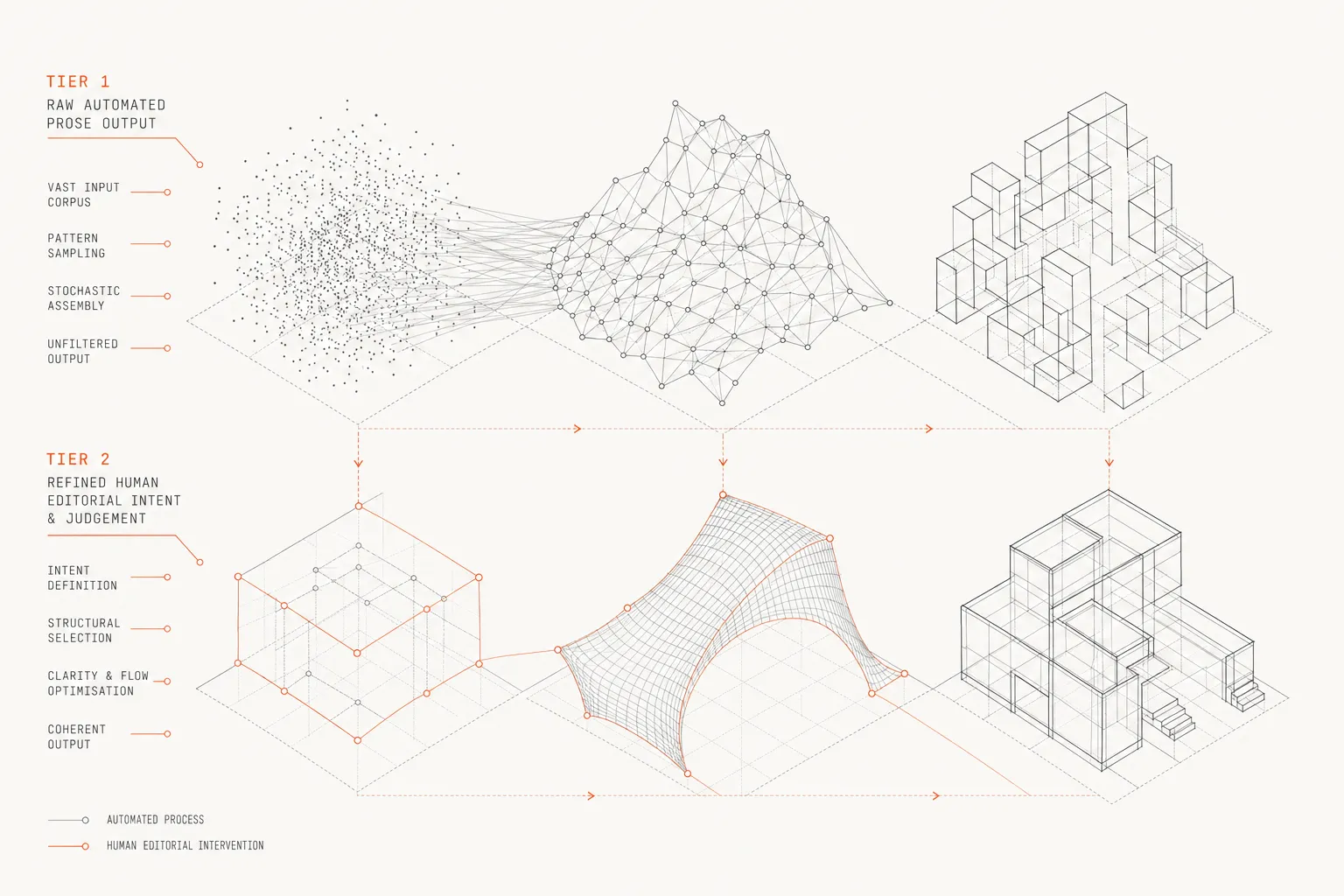
What matters? What doesn’t? What is the relationship between these facts? What is missing? Which apparent correlation is actually causal? What do I believe after looking at all of this? And can I construct a story that allows another human being to see what I see?
Those are writing questions, but they are also product questions, management questions, scientific questions, and increasingly AI questions.
The Storyteller Has Not Disappeared
There is another paradox here. The people building the technologies supposedly making human communication less valuable have themselves become extraordinary exercises in narrative.
The people building AI are telling stories, not just publishing model cards. Sam Altman isn’t simply the chief executive of an AI company. He has become one of the principal narrators of a particular technological future: intelligence becoming abundant, scientific progress accelerating, the economics of work changing.
Dario Amodei offers a different narrative—more cautious, more explicitly concerned with the risks of powerful systems. His recent essay The Adolescence of Technology doesn’t merely enumerate technical risks. It tells a story about humanity approaching a test of its character.
And perhaps most interestingly, Anthropic’s president Daniela Amodei—who studied literature rather than computer science—has been arguing that studying the humanities will become “more important than ever.”
Her reasoning is worth paying attention to. As machines become exceptionally good at technical tasks, she argues, understanding ourselves, understanding history, communicating, thinking critically, and understanding other people do not become less important. They become more so.
That sounds counterintuitive only if we assume the purpose of the humanities was to manufacture text. It wasn’t.
Storytelling After AI
For those of us actually adopting AI inside organisations, this distinction becomes concrete very quickly.
The model can summarise a dataset. It cannot decide, without some conception of the world around that dataset, whether the dataset represents reality.
It can produce ten recommendations. It does not inherently know which recommendation an institution is actually capable of executing.
It can find anomalies. It cannot tell you whether the anomaly is an error, an injustice, an interesting edge case, or the most important thing on the page unless someone has constructed the context in which those distinctions mean something.
AI is extraordinarily good at answering questions. A large part of human work remains figuring out which question is worth asking.
That is why storytelling matters even for people who would never describe themselves as storytellers:
- A product manager is constructing a story about a user and a problem.
- A founder is constructing a story about a future that doesn't exist yet.
- A policymaker is constructing a story about why one intervention should produce a particular outcome.
- A scientist is constructing a story that connects observations into an explanation.
- An AI practitioner is constantly constructing stories about the relationship between messy reality, data, and what a model says.
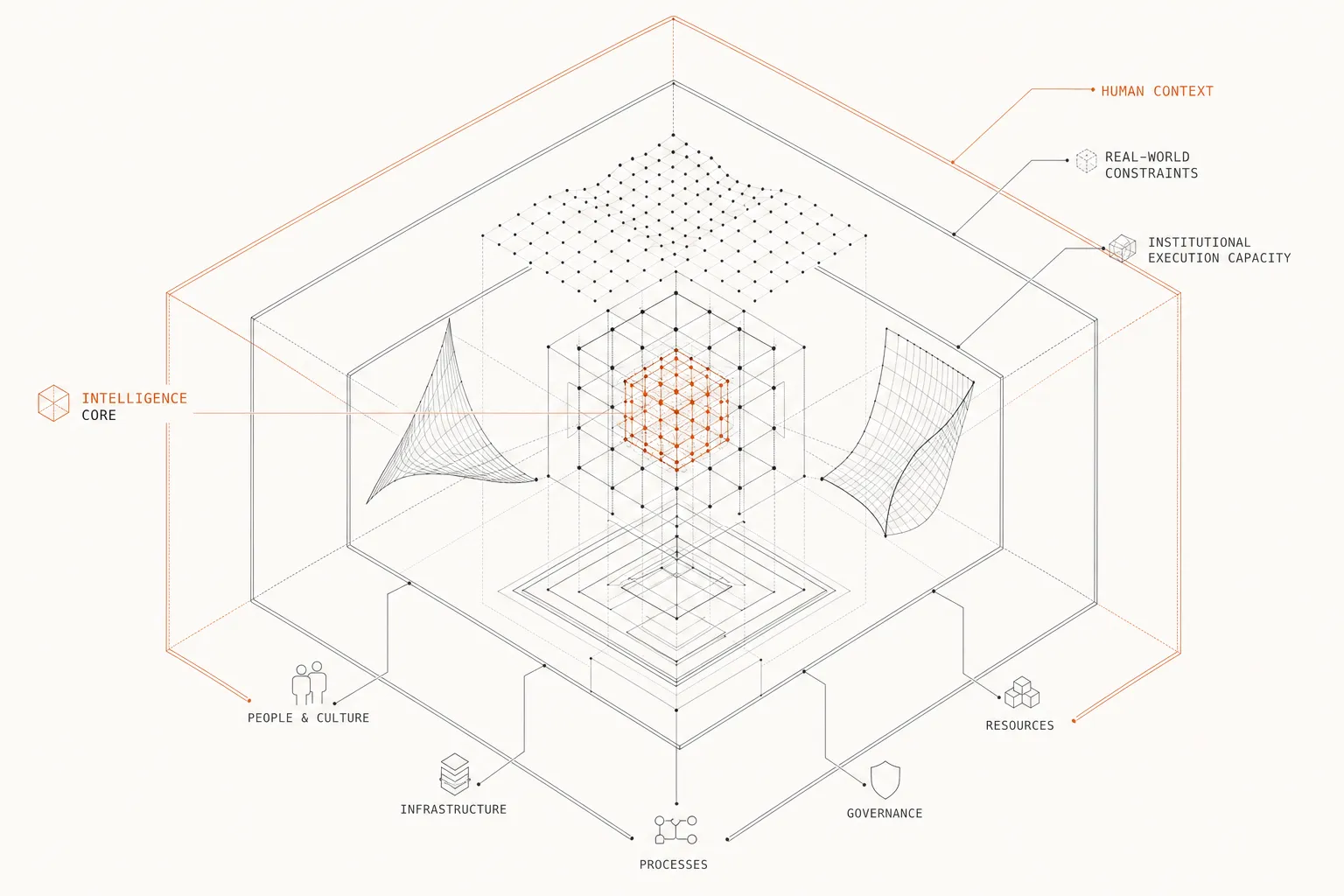
The danger isn’t that AI learns to tell those stories. It is that we become so impressed by its ability to construct a convincing narrative that we forget the harder responsibility of deciding whether the narrative is true.
Why the Writing Center Matters
Which brings me back to Harvard. A writing center can look strangely old-fashioned in 2026. Students have ChatGPT, Claude, and Gemini. Harvard itself provides access to these tools. Harper cites a Harvard Crimson survey in which students reported using AI for more than a third of their homework.
Why maintain a place where another human being sits beside you and asks why this paragraph is here, what you mean by this sentence, or whether your conclusion actually follows from your argument?
Perhaps because those questions are the point.
The Writing Center was never about producing grammatically correct sentences. It was valuable because another person could force students to confront their own thinking.
There is a temptation to imagine education in the AI era as a process of deciding which old skills machines have rendered unnecessary. Writing may belong in exactly the opposite category.
The cheaper AI makes words, the more valuable it becomes to know which words are actually yours.
I don’t want to stop writing with AI. It has made me faster. Sometimes it makes me clearer. Occasionally it finds the formulation I have been circling for hours. But I increasingly want to preserve the moment before I ask it for help: the messy note, the unfinished sentence, the argument I have to wrestle with myself.
Keene’s old advice may need only a small amendment for the AI age. The predictor of success may no longer be simply how well you can write. It may be whether, when a machine can write almost anything for you, you still know what you want to say.