
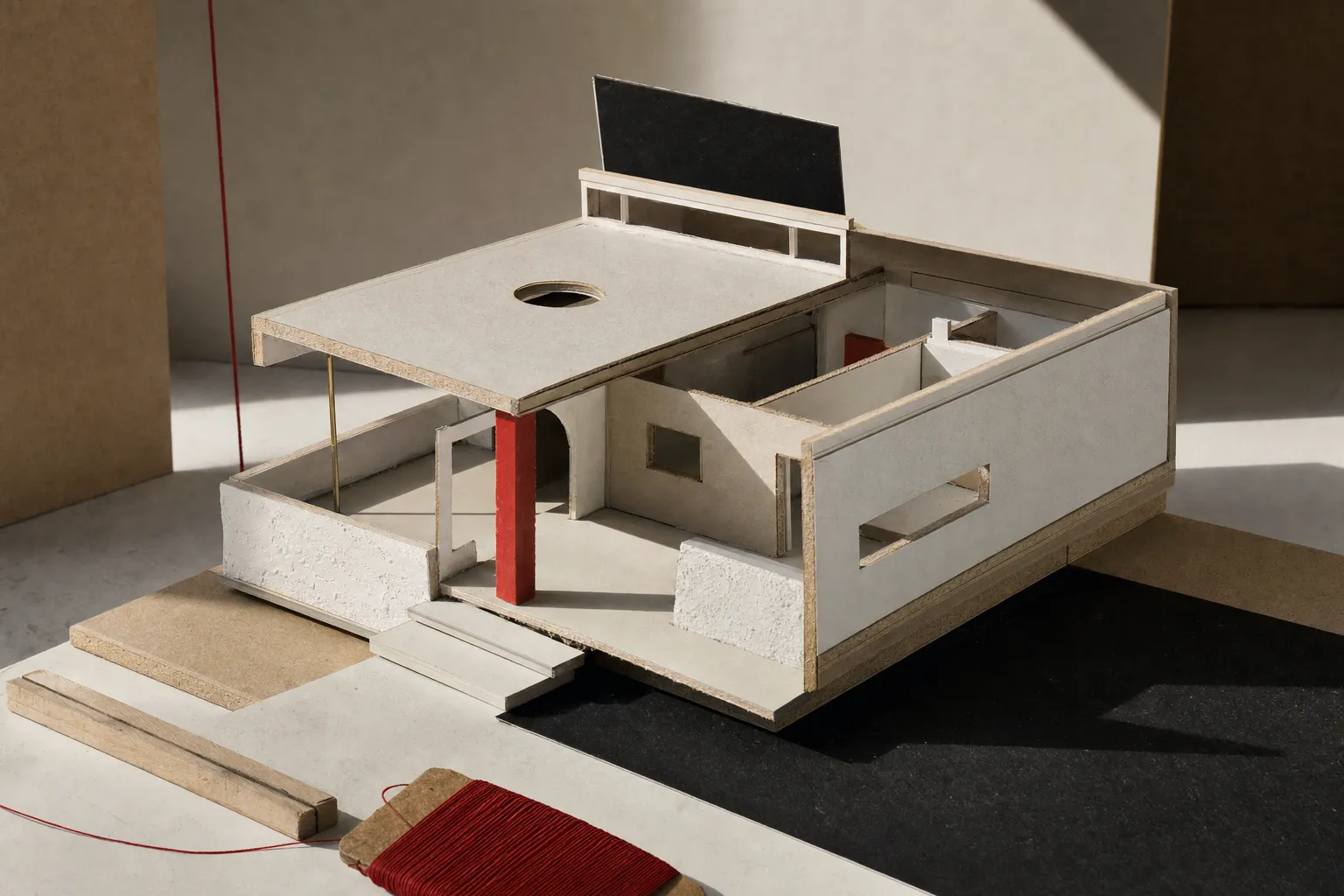
I started with a PDF of a house. I wanted to recreate it in three dimensions, explore the result, and develop the design through different versions. Astra, working with Blender through MCP, produced GLB files and alternatives I could inspect and keep revising.
The more specific my requirements became, the more useful that workflow felt. For the house I was trying to recreate, it offered more control than the image- and model-based workflows I explored in World Labs’ Marble and Chisel.
World-generation products now have to compete with agents that can operate mature modeling tools. As the effort of producing editable geometry falls, a shortcut around modeling has to offer something valuable beyond avoiding the modeling itself.
A house is a revealing test because it already contains decisions. Its layout, openings, proportions, and connections between spaces are commitments that later changes need to respect. Moving furniture or changing the aesthetic should not casually reopen them.
A reference photograph can guide a new version’s palette, materials, lighting, and furnishing language. That makes it possible to explore different aesthetic directions while treating the underlying house as a constraint. The value lies in being able to develop alternatives for a particular space and carry the useful decisions from one version into the next.
For professional design, each successful revision should leave more of the project resolved.
This is what made the Astra-and-Blender combination compelling to me. Instructions could become changes to an editable scene. The resulting geometry remained available for inspection and further work. Specificity had somewhere to live.
OpenAI’s architectural visualization example demonstrates the same continuity: Astra develops a floor plan, builds editable Blender geometry, models furniture and fixtures, and carries the scene into an interactive Unreal walkthrough. Later requests become further work on the same environment.
In my experiment, the GLBs were already three-dimensional and could be explored in an appropriate viewer. Gaussian splats were optional. GLB is a portable scene format for delivering geometry and materials to applications and engines.
The Blender scene can remain the editable source, with GLB serving as a convenient viewing and sharing format. Once that arrangement works, another generation step needs to justify its contribution.
Chisel’s workflow made the tradeoff clear. It takes a coarse 3D scene, establishes a panorama viewpoint, and proceeds through panorama, draft, and world generation. Geometry guides the spatial arrangement; a prompt guides the appearance. World Labs documents this in its Chisel guide and creation workflow.
The intermediate panorama matters. The public API exposes depth-to-RGB generation: a depth image and a visual brief produce a panoramic image, which can subsequently become a world. The documentation describes the synthesized textures as adhering loosely to the supplied geometry.
That is useful when I want a system to elaborate on a rough spatial arrangement. Its value becomes less obvious as the source model becomes more complete.
Rendering a model into a panorama reduces it to an observation from a single camera position. Reconstructing a world from that image introduces inference again. Exact dimensions, hidden surfaces, object boundaries, and design relationships are not automatically preserved through the conversion.
The richer the source model, the more consequential that loss can become. A doorway’s position may already be settled. A room connection may already have been checked. Those are decisions I want the workflow to retain.
Astra could help produce better panoramas from the Blender scene, and those could feed Marble when the resulting visual enrichment is worthwhile. But an attractive panorama does not guarantee faithful reconstructed geometry. When the original model already supports exploration, I can bypass that round trip.
The whole-house workflow exposes the same tension at a larger scale. World Labs’ documented approach is to generate rooms separately and assemble them in Studio Compose. Users position, rotate, and scale the worlds, then align floors and doorways. Its documentation states that there is no floor-plan input that automatically connects the rooms.
Assembling scenes can be a productive way to invent an environment. Recreating a house from a plan carries a different obligation: the relationships between those rooms are part of the brief. Rebuilding them after generation adds work that a coherent source model should help avoid.
Specialized generative 3D products offer considerable value when they bypass extensive manual authoring. An agent operating Blender changes the cost of that alternative. It can write modeling code, use existing assets, alter materials, render views, and help inspect the result. The capabilities of established software become accessible through instructions.
The relevant comparison includes the work after the first scene appears. Correcting errors, preserving dimensions, making revisions, and delivering a version that satisfies the brief are where the hours accumulate. A faster initial generation can lose its advantage if each subsequent change requires more reconstruction and cleanup.
For my house experiment, Astra with Blender MCP was the stronger starting point. Chisel’s current workflow felt better suited to visual exploration and spatial elaboration than to developing a specific design through successive changes.
That judgment is about control. A generated environment can have impressive visual fidelity while offering limited control over its components. Splats can also represent real, photographed places. Dismissing World Labs as useful only for imaginary worlds would miss both distinctions.
Atlas gives me reason to expect a more compelling next chapter.
Announced on September 1, 2026, Atlas brings images, video, camera poses, and depth into a shared spatial context. World Labs describes capabilities spanning generation, reconstruction, and simulation, including reconstruction of real environments from multiple views. It entered early access with the stated intention of powering future versions of Marble.
That direction could substantially change my assessment. For the work I care about, the test will be how reliably the system incorporates new evidence and requested changes while retaining the spatial information already established.
Even a much stronger world model will face the same competitive reality: agents are making editable 3D easier to produce. Generative workflows will increasingly need to demonstrate what they add to a scene that an agent can already build, inspect, and revise.
For architecture and interiors, this raises the standard of useful automation. A system should help express a brief spatially, expose mistakes, explore alternatives, and preserve accepted decisions. An AI-generated GLB still needs its geometry checked; an editable source makes dimensions, objects, and relationships available for that work.
My experience began with a PDF and produced versions of a house I could explore. What mattered most was the ability to keep developing that house as my instructions became more specific.
The next generation of spatial tools will earn its place by making that continuity dependable. Once a design decision has been made, every subsequent step should build on it. An agent with Blender is already making that a reasonable expectation.