
In a recent developer demonstration, OpenAI’s Astra helped build a space exploration game containing more than 10,000 procedurally generated planets. Players could travel toward a distant world, descend through its atmosphere, land, and walk around. Astra helped construct the rendering, terrain, navigation, and testing systems that made the experience possible. OpenAI’s account
The demonstration illustrates a rapidly improving ability to turn human intent into interactive environments. In this case, AI helped write a simulation in code. Elsewhere, researchers are training neural networks to predict how environments evolve. Other systems reconstruct persistent three-dimensional spaces from photographs and video.
These capabilities are developing along different paths, but their convergence could change the economics of digital twins and the organization of architecture, engineering, and construction.
It also raises a more fundamental possibility: much of the workflow surrounding Building Information Modeling, or BIM, may exist because humans need elaborate mechanisms to express spatial intentions, coordinate specialized teams, and keep different representations consistent. If AI can absorb that work, BIM’s current form may become an intermediate stage in the history of designing buildings.
BIM could become something an intelligent system maintains and produces, while people work through intentions, experiences, constraints, and decisions.
A world model represents an environment and predicts aspects of its evolution. For an agent making decisions, its practical purpose is to answer a question: given the current situation, what might happen if I take this action?
The environment need not be a photorealistic landscape. It could be a robot’s workspace, a production line, or a system of queues and capacities. What matters is whether the representation captures the relationships needed to anticipate consequences.
The exciting possibility is that experience becomes programmable. An agent could encounter a situation, explore alternative actions, observe their simulated consequences, and improve before acting in the physical world. Designers could use the same capability to investigate proposed environments before committing to them.
There are several overlapping ways to build these capabilities:
| Approach | What it represents or produces | Main contribution |
|---|---|---|
| Generative video world models, such as Genie | Future visual observations conditioned on previous observations and actions | Rich, responsive environments learned from video |
| Predictive representations, such as V-JEPA | Compact internal features of observations; action-conditioned variants support planning | Prediction without having to reconstruct every visible detail |
| Models learned for control, such as Dreamer and TD-MPC2 | Dynamics and decision-relevant information learned alongside an agent | A direct connection between simulated futures and better actions |
| Spatial models, such as Marble and Atlas | Reconstructed or generated three-dimensional environments | Persistent spatial structure and exportable assets |
| Programmatic simulations, including worlds built with coding agents | Executable rules, geometry, state, and rendering | Repeatability, inspectable logic, and conventional software tooling |
| Hybrid systems | Combinations of structured state, physics, and learned prediction or generation | Known constraints combined with flexible learned capabilities |
The differences concern what is represented, what the system learns, and how it is used. “Transformer,” “diffusion,” and “world model” describe different aspects of a system. Atlas, for example, combines autoregressive generation, diffusion, and transformers within a model that operates across spatially grounded inputs. Atlas technical description
These approaches also have different limits. Stable geometry does not automatically provide accurate dynamics. A video that looks convincing can contain physical errors. A simulation written in code behaves according to its implemented rules. A compact predictive representation can omit information that matters for a particular task. The appropriate combination depends on the decision being supported. Genie 3, V-JEPA 2, TD-MPC2
The progress becomes clearer when viewed across three time horizons.
By 2023, world models already had a substantial research history. DreamerV3 demonstrated a learning algorithm that worked across diverse games and control environments. Over the following three years, the field expanded toward broader pretraining and environments generated from flexible inputs. In February 2024, Genie demonstrated controllable environments learned from internet video without ground-truth action labels. DreamerV3, Genie
By June 2025, V-JEPA 2 combined pretraining on more than one million hours of internet video with an action-conditioned model trained using under 62 hours of robot video. Its researchers demonstrated picking and placing with Franka arms in two labs without collecting additional training data in those deployment environments. This was a bounded result, but an important example of broad visual learning supporting physical planning. In August 2025, Genie 3 demonstrated interactive generation at 24 frames per second and 720p, maintaining consistency for a few minutes. V-JEPA 2 results, Genie 3 announcement
Over the last year, the emphasis broadened toward usable outputs and connections to agents. Marble’s November 2025 release supported generating, editing, expanding, and exporting worlds; its January 2026 API made world generation programmable within other applications. Google’s November 2025 SIMA 2 research demonstrated an agent improving through experience in Genie-generated environments. NVIDIA’s May 2026 Cosmos 3 announcement combined visual reasoning, world generation, and action prediction. These developments began connecting environment creation to experimentation and learning. Marble, World API, SIMA 2, Cosmos 3
The most recent three months, from 8 June to 8 September 2026, show further convergence. NVIDIA released the four-billion-parameter Cosmos 3 Edge in July for local deployment and announced simulators that respond to an agent’s actions. World Labs introduced Atlas on 1 September, bringing generation, reconstruction, and simulation into a shared architecture, with early-access registration. Astra’s September game-building example demonstrated stronger authorship of complete interactive environments. The advances concern deployment, spatial modeling, and software construction; they do not all demonstrate the same capability. NVIDIA’s July announcement, Atlas, Astra
Together, these changes give digital twins a credible path toward much wider economic usefulness.
A digital twin has an obligation to a particular reality. An operational twin of a warehouse must represent that warehouse’s relevant conditions, rather than a plausible warehouse in general. The Digital Twin Consortium’s definition emphasizes a representation connected to real entities and processes through synchronization at an appropriate frequency and fidelity. Digital Twin Consortium
This is precisely the operational boundary dg2n addresses—building digital twins for retailers across stores, dark-stores, and warehouses by unifying 3D spatial representations with AI. When physical environments change daily, static CAD files fail; the twin must continuously reflect space, inventory, and operational movement.
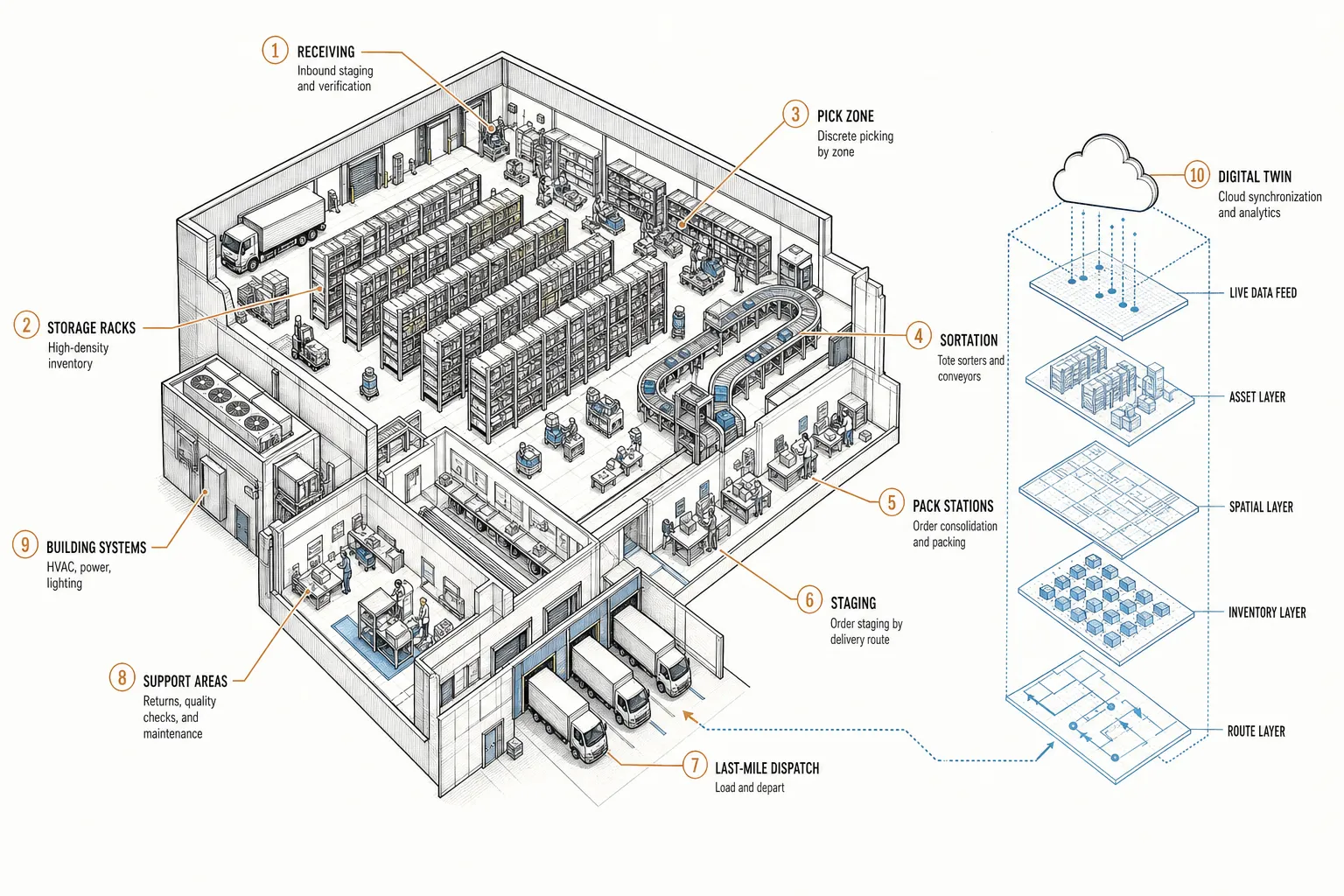
Building that connection takes work. Geometry must be assembled, data integrated, behavior modeled, assumptions checked, and changes incorporated. The twin must also help someone make a decision valuable enough to justify its upkeep.
AI can potentially reduce several of those costs at once. Spatial models can help reconstruct environments. Coding agents can build simulation tools and integrations. Learned models can contribute predictions. Agents can run experiments and make the results accessible to people who would otherwise need specialist software skills.
Digital twins already deliver value in specific applications. In June 2025, BMW reported that it was scaling applications across twins of more than 30 production sites. It said a collision-checking procedure that previously required almost four weeks of physical testing could be simulated in three days. This is evidence of an operational benefit, although it should not be attributed entirely to generative AI. BMW’s report
The threshold for broader adoption is economic: keeping a twin sufficiently accurate must cost less than the mistakes and experiments it helps avoid. World models and agents offer new ways to move that threshold.
For AEC, the analogy with digital product design is especially useful.
AI tools have shortened the path from a description or design to a functioning interface. Figma Make, for example, can turn existing designs and natural-language instructions into interactive prototypes. This changes how teams explore and assess ideas. It does not, by itself, establish a collapse in the total value of designers. It does demonstrate that the production of certain artifacts and the handoffs around them can become much cheaper. Figma Make
AEC could experience a related change. Clients who struggle to interpret plans may be able to evaluate a space they can explore. Architects could incorporate that feedback while investigating alternatives. Engineers and cost specialists could assess consequences earlier, with fewer translations between separate representations.
Consider a hypothetical review of a housing project. The client asks the team to preserve the footprint, improve daylight, simplify the structure, and compare the cost of a different unit mix. An integrated AI system could generate alternatives, make them explorable, invoke the relevant analysis tools, and show which objectives conflict. Accepted changes would then propagate through the project’s information.
Parts of that workflow are already visible. Autodesk Forma Site Design supports generating and comparing layouts alongside sun, daylight, and wind analysis. Autodesk’s neural CAD research targets editable geometry, constraints, and design intent. These are distinct developments, but they indicate how spatial experience could connect to precise design work. Forma’s August 2026 overview, Neural CAD research
An initial response is to imagine adding world models and AI assistants to the existing BIM process. That may be a practical transition. The more consequential question is whether the existing process remains the right organizing structure.
BIM combines building information with methods for creating, exchanging, and managing it. Its current workflows address several human limitations: expressing spatial intentions precisely, understanding other disciplines’ decisions, managing dependencies, and keeping teams aligned as a design changes.
Existing BIM already automates parts of this coordination. The remaining work still involves people translating intentions into modeling operations, interpreting clashes, reconciling models, and preparing information for other participants.
If AI can perform those translations and checks reliably, the project model can become state that the system maintains.
An architect could express a desired spatial quality and constraints. A structural engineer could specify acceptable behavior and construction preferences. A cost specialist could provide commercial assumptions. The system could identify inconsistencies, generate alternatives, and present the consequences of proposed decisions.
Its internal organization would not necessarily need to reproduce the interfaces, files, or discipline boundaries through which human teams currently work.
This does not imply that buildings cease to require precise information. Dimensions, materials, relationships, accepted decisions, and measured conditions remain essential. It means that maintaining this information could become substantially more automatic, and the human interface to it could change.
Drawings, quantities, schedules, and exchange models could increasingly be generated as needed from maintained project information. Standards could remain useful underneath the workflow. IFC already explicitly supports machine interpretation and automation; such standards might become less visible to users while retaining their role in interoperability. buildingSMART’s IFC description
Under this scenario, BIM becomes an implementation detail and, where required, an output of an intelligent design and delivery system. Retaining the label would conceal a considerable change in how work gets done.
The transition would be uneven. Concepts, visualization, and presentations are natural early targets. Documentation and model production require more reliable control of precise relationships. Engineering requires dependable analysis. Construction introduces variable site conditions, supply constraints, and physical work that faster software does not automatically accelerate.
Those differences affect the pace of change. They do not establish that today’s software interfaces, staffing patterns, or commercial arrangements must remain intact.
Some coordination problems also reflect genuinely different objectives. More usable area, lower cost, easier maintenance, and a particular architectural experience can conflict. AI can evaluate and explain these tradeoffs; the project still needs a basis for choosing among them.
Likewise, realism must be evaluated separately from predictive accuracy. Physics-IQ’s 2025 study found that visual realism did not reliably indicate physical understanding in the video models it tested. Those results concern that generation of models, but they establish a useful principle for assessing future systems. Physics-IQ research
For a decision-making system, the relevant evidence is whether it preserves important state, predicts consequences accurately enough for the task, and improves outcomes in unfamiliar real situations. A generated walkthrough, a schema-valid model, and an engineering-verified design establish different things.
The commercial implications could be substantial even before full automation becomes possible.
If producing and coordinating artifacts requires fewer hours, firms whose revenue depends heavily on those hours may face pricing pressure. Smaller teams could deliver a broader scope. Clients may expect more alternatives and clearer evidence behind recommendations. The ability to produce a convincing first proposal could become less differentiating.
Value could move toward understanding the brief, choosing useful constraints, resolving tradeoffs, and demonstrating that a project can meet its objectives. Firms may increasingly compete on the quality and speed of validated decisions: what to build, how to build it, and how it will perform.
The technology market could change alongside the professional market. Interfaces and workflows designed around manual authoring may lose some of their centrality. Reliable geometry, analysis engines, project data, interoperability, and connections to delivery remain valuable capabilities. The advantage could accrue to systems that combine them into a dependable decision process.
This is also where the digital twin connects design to a longer relationship with the asset.
Design records intended performance. Construction reveals what was built. Operations reveals how it behaves. Keeping those connected could allow a firm to compare predictions with outcomes, improve subsequent projects, and provide continuing optimization services.
Siemens and NVIDIA’s January 2026 partnership describes a related direction: analyze twins, test improvements virtually, and translate validated results into operational changes. It is a stated development program rather than evidence that autonomous optimization is universally solved, but it makes the intended connection explicit. Joint announcement
For AEC firms and technology companies, the opportunity is to shorten the path from intent to a validated, costed, buildable decision, then preserve the connection between that decision and what happens in reality.
That possibility extends well beyond making existing tools easier to operate. It allows the industry to reconsider which work must be performed explicitly by people, which representations must be authored by hand, and which handoffs are necessary.
World models make spatial experience and prediction more accessible. Digital twins connect models to particular realities. Agents can carry intentions across tools and representations. As these capabilities become more dependable, the coordination work around BIM could recede into the system.
The building would still require precise knowledge. The people creating it could spend far less of their working lives managing the machinery through which that knowledge is expressed.