Tech Companies as New-Age Zamindars: Public Rails, AI Agency, and Governance
How open infrastructure, AI agency, and reality interpretation prevent digital platforms from becoming private estates.
Essays, field notes and experiments on AI, physical computing, geometry, and the built environment.

How open infrastructure, AI agency, and reality interpretation prevent digital platforms from becoming private estates.
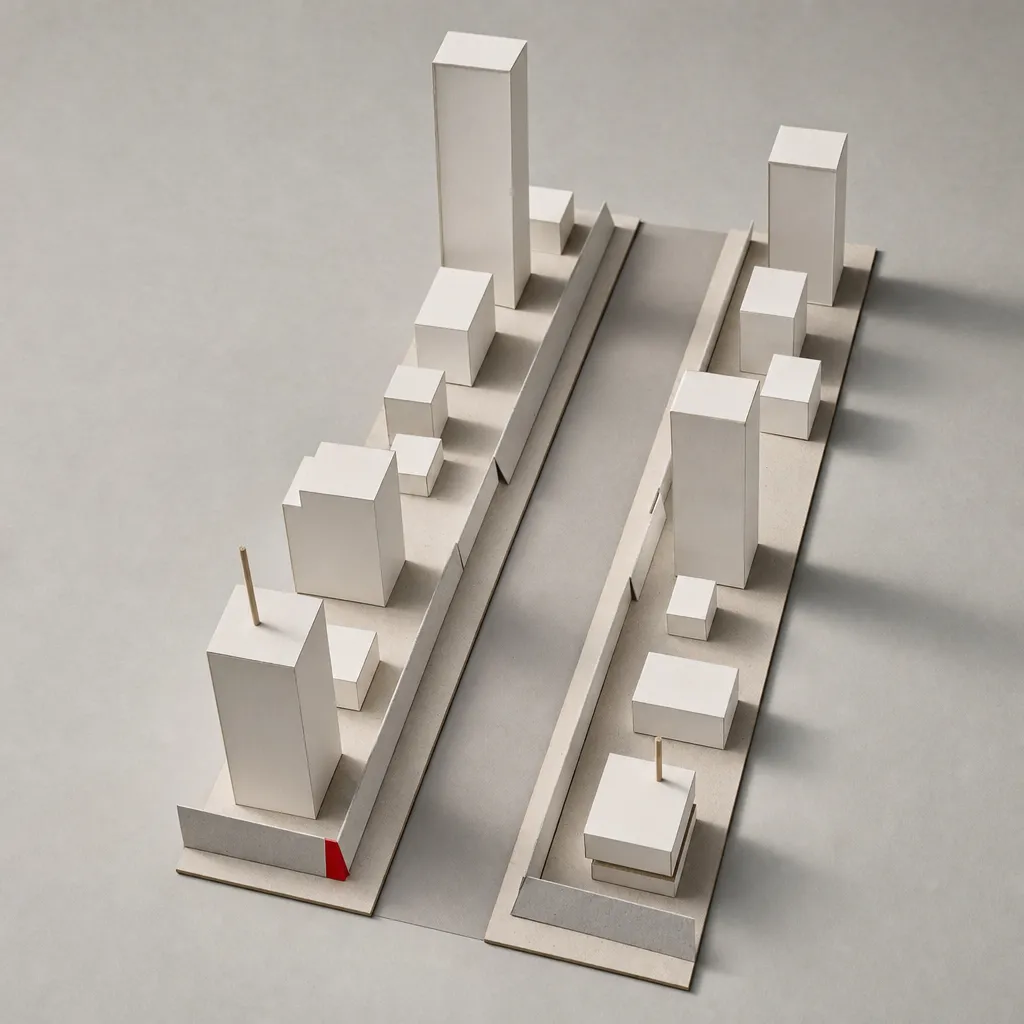
Increasing floor area ratio changes how much gets built, but never how buildings meet the street.

Why state housing designs go unused, and how speed-of-permitting reform creates the one window to attach design to choice.

Redirecting mandatory architectural internships into municipal design cells gives students placements and cities in-house capacity.

Online design platforms brought ₹1,999 house elevations to every district in India, but generating pictures didn't solve whether the houses work.

How a mandatory fee floor and a title-only law left Indian architects out of the housing market

Why Jaipur's heritage regulations work while Ahmedabad's stall, and how spatial rents make urban conservation enforce itself.

How credit, setbacks, concrete supply, and split governance produce the look of the ordinary Indian street.

A planner is only as good as the space it searches. Fix the geometry first and the planning gets easy.

The internet is no longer majority human. A fleet of sunken battleships suggests what happens next.

Why BIM cannot compose: moving the built environment from locked CAD files to executable spatial contracts.

Why warehouse pick timestamps fail to explain fulfillment bottlenecks without a spatial model of the physical floor.

Decades into the smart city experiment, AI is shifting urban technology from watching reality to participating in it.

The internet was written by hand until it wasn't. The built world is next, and the scarce thing at the far end of that shift is not drawing.

Multimodal AI moves advertising from demographic probability to probabilistic models of individual judgment and context-dependent choice.

The falling cost of editable 3D is changing the benchmark for generative worlds.

World models, digital twins, and the redesign of how the built world is conceived, coordinated, and operated.

The enterprise asset is the accumulated ability to specify, evaluate, and reproduce what works.

Physical AI is arriving faster than the infrastructure that carries it. Small businesses are where those two facts collide.

When execution and intelligence become abundant, the human boundary moves from generating answers to deciding which futures are worth choosing.

When raw intelligence becomes cheap, value migrates from software seats and labor hours to the delegation of trusted work.

Why the two most valuable phases of independent hospitality happen before arrival and after departure.

Why digital twins in India are about spatial resolution and physical decisions, not 3D dashboards

Beyond adaptable software lies the harder challenge: building a continuously maintained state of reality that governments can actually reason over.

As software costs collapse, India’s next macroeconomic advantage depends on turning metered inference into productive capital.

When machines can write almost anything, the scarce asset is knowing what you actually mean.

Reality capture is no longer the bottleneck. VLMs convert physical space into natural language, turning camera feeds into queryable world models.

The fresh supply chain spends billions chilling managed corpses. Plant physiology suggests a far simpler alternative: keep produce alive all the way to the plate.

John Berger, Wittgenstein, and the vision-language state.

How open weights, quantization, and local inference are rewriting the geopolitical supply chain of artificial intelligence.

When the unit of government software stops being the dashboard and starts being the decision.

Before AI can predict or automate, it has to answer deceptively basic questions about where things are and what they correspond to.

What looks like enterprise AI pessimism is a strategic narrative war over market architecture and value capture.

LLMs conquered the textual surface of legal practice. The institutional context remains an unsolved system-design problem.

AI makes government software easy to build but hard to buy—shifting the real moat from generated dashboards to ground-truth civic semantics.

Why we stopped writing solvers and started writing the thing that writes them

A technical appraisal of gravity-glide urban transit

Why the hardest problem in enterprise software is a modelling error, and why the fix has to be free

Consumer decision trees model an averaged shopper who does not exist, and function alone has stopped being sufficient to sell

Phantom infrastructure, public art, and the case for civic self-annotation

Why physical intelligence requires capex substitution, edge perception, and owning the unrecorded state of space over time.

Why the spatial turn in artificial intelligence is a data argument, not a display argument

Deep tech, government, and the decade India built its own substrate

Why physical retail must become a digital substrate before agentic AI can run it.

The intelligence race pushes AI onto owned hardware, then onto your body. A three-to-four-year chain, told as a story.